Your website might look perfect on your desktop, but appears broken and unusable when customers visit from their phones or tablets. This disconnect costs Dubai businesses countless potential clients every day. Responsive web design solves this challenge by ensuring your site adapts seamlessly to any device, delivering consistent experiences that keep visitors engaged and ready to buy.
Table of Contents
- Understanding Responsive Web Design And Its Core Principles
- Why Responsive Web Design Is Critical For Dubai Businesses In 2026
- Responsive Design Vs. Alternatives: Why It Beats Separate Mobile Sites And Apps
- How To Implement Responsive Web Design For Your Business Website
- Explore Professional Responsive Web Design Services In Dubai
Key takeaways
| Point | Details |
|---|---|
| Automatic adaptation | Responsive web design adjusts your site layout to any screen size without manual intervention |
| Mobile-first benefits | Starting with mobile design improves both user experience and search engine rankings |
| Single codebase efficiency | One responsive site requires less maintenance than separate desktop and mobile versions |
| SEO advantage | Google prioritizes mobile-friendly responsive websites in 2026 search results |
| Future-proof flexibility | Responsive design automatically supports new devices like foldables and smart TVs |
Understanding responsive web design and its core principles
Responsive web design ensures websites render well on all screen sizes and resolutions. Instead of creating separate websites for different devices, responsive design uses flexible layouts that automatically adjust based on the viewer’s screen.
The magic happens through several technical components working together. Fluid grids replace fixed pixel measurements with proportional sizing, allowing elements to resize relative to the screen width. Media queries detect device characteristics like width and resolution, then apply appropriate CSS styling rules. The viewport meta tag ensures proper scaling on mobile devices, preventing awkward zooming or tiny text.
Mobile-first design represents a fundamental shift in how developers approach website creation:
- Design for the smallest screens first, then progressively enhance for larger displays
- Prioritize essential content and features that matter most to mobile users
- Add complexity and decorative elements only when screen real estate allows
- Test functionality on actual devices throughout the development process
Relative units like percentages and ems create truly flexible layouts. Where old websites used rigid 960-pixel containers, responsive sites use containers that expand to 90% of available width. This approach maintains readability whether someone views your site on a 320-pixel phone or a 2560-pixel desktop monitor.
HTML text naturally reflows to fit different widths, but CSS provides the real responsive control. Through carefully crafted media queries, you can hide sidebars on phones, stack navigation vertically on tablets, or display multi-column layouts on desktops. The result is consistency and usability across every device your Dubai customers use.
Pro Tip: Start your PSD to responsive HTML conversion with mobile breakpoints first, ensuring your design works beautifully on the devices most Dubai shoppers actually use to browse.
Why responsive web design is critical for Dubai businesses in 2026
Mobile devices generate approximately 60% of web traffic worldwide, and Dubai follows this global trend closely. Your potential customers browse during commutes, while waiting for meetings, and during evening relaxation on tablets. If your site doesn’t work perfectly on their devices, they’ll simply visit a competitor who invested in proper responsive design.

Google’s mobile-first indexing fundamentally changed how search engines evaluate websites. The search giant now primarily uses your mobile site version for ranking, even for desktop searches. Non-responsive sites face ranking penalties that push them down in search results, making them virtually invisible to Dubai customers searching for your services.
60% of global web traffic comes from mobile devices in 2026
Consistent user experience directly impacts your bottom line. When visitors encounter broken layouts, unreadable text, or buttons they can’t tap, they leave immediately. Bounce rates skyrocket and conversion rates plummet. Responsive design eliminates these friction points, creating smooth experiences that guide visitors toward purchases or contact forms.
The business case for responsive design includes several compelling advantages:
- Single codebase reduces development time and launch costs significantly
- Unified analytics provide clearer insights into customer behavior across devices
- Brand consistency strengthens recognition whether customers browse on phone or desktop
- Faster content updates reach all users simultaneously without duplicate work
- Lower maintenance costs over the website’s lifetime compared to separate versions
Dubai’s competitive business environment demands every advantage. Your responsive website becomes a 24/7 sales representative that works perfectly regardless of how customers access it. Combined with effective search engine optimization, responsive design positions your business to capture more qualified leads and convert them into loyal customers.
Responsive design vs. alternatives: why it beats separate mobile sites and apps
Some businesses consider maintaining separate mobile sites (often using m.domain.com URLs) as an alternative to responsive design. This approach doubles your workload. Every content update, security patch, or design tweak requires implementation twice. Bugs multiply because each codebase develops its own quirks and issues.
Native mobile apps represent another path some explore. While apps excel for specific use cases like banking or food delivery, they limit your reach dramatically. Customers must find your app in crowded app stores, download it, grant permissions, and keep it updated. Most small businesses lack the resources to maintain quality iOS and Android apps alongside their website.
Responsive design maintains one codebase that automatically serves all devices appropriately. This efficiency translates into faster feature deployment, easier quality control, and significant cost savings. When you want to update your services or pricing, you make changes once and they appear everywhere instantly.
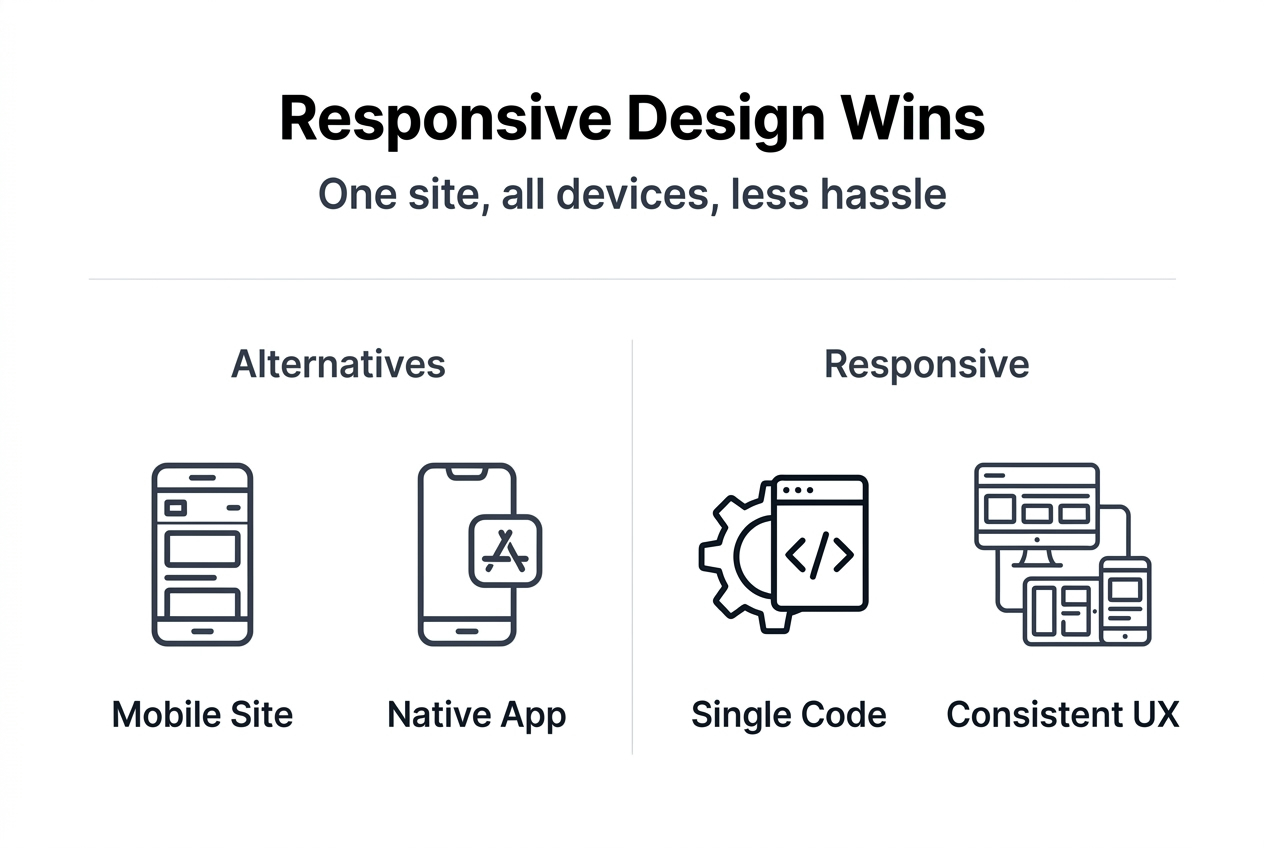
| Approach | Performance | Cost | User Experience | Maintenance |
|---|---|---|---|---|
| Responsive Design | Fast with optimization | Moderate initial, low ongoing | Consistent across devices | Single codebase updates |
| Separate Mobile Site | Variable, often slower | High initial, high ongoing | Inconsistent branding | Double development effort |
| Native Apps | Excellent | Very high | Platform-specific | Separate iOS/Android teams |
| Desktop-Only Site | Fast on desktop | Low initial | Broken on mobile | Simple but inadequate |
The future-proofing advantage of responsive design becomes increasingly valuable as device diversity expands. Foldable phones, smart TVs, car displays, and devices we haven’t imagined yet will all benefit from responsive layouts that adapt intelligently. Your investment today protects against obsolescence tomorrow.
Brand consistency matters more than many business owners realize. When customers see different layouts, colors, or navigation between your mobile and desktop sites, it erodes trust. Responsive design ensures your carefully crafted brand identity remains intact regardless of viewing context.
Pro Tip: If you’re considering a website redesign strategy, responsive design should be your foundation, not an afterthought or optional upgrade.
How to implement responsive web design for your business website
Implementing responsive design requires strategic planning and careful execution. Following these steps ensures your Dubai business website delivers excellent experiences across all devices:
- Adopt mobile-first design thinking by sketching layouts for phone screens before expanding to tablets and desktops, ensuring core functionality works on constrained displays
- Build flexible grid systems using CSS frameworks or custom code with percentage-based widths that scale proportionally rather than breaking at unexpected screen sizes
- Define breakpoints strategically at common device widths like 576px, 768px, 992px, and 1200px, applying media queries to adjust layouts smoothly between these thresholds
- Optimize images and media by serving appropriately sized files for each device, using responsive image techniques and lazy loading to accelerate mobile performance
- Test extensively on real devices popular in Dubai markets, including various iPhone and Android models, iPads, and desktop browsers to catch display issues
- Implement touch-friendly interfaces with buttons sized for finger taps (minimum 44×44 pixels), adequate spacing between interactive elements, and gesture support where appropriate
- Monitor performance metrics like mobile page speed, bounce rates by device, and conversion rates to identify optimization opportunities after launch
Modern frameworks simplify responsive development considerably. Bootstrap, Foundation, and Tailwind CSS provide pre-built responsive components that handle common layout challenges. WordPress themes often include responsive features by default, though customization ensures your site stands out from competitors using identical templates.
Mobile traffic dominates many industries, making mobile-first design essential rather than optional. This approach forces you to prioritize what matters most to customers, eliminating clutter and focusing on conversion-driving elements.
Collaboration with experienced Dubai web designers familiar with regional user behavior accelerates success. Local designers understand cultural preferences, browsing patterns specific to UAE audiences, and technical considerations like Arabic language support for bilingual sites. Their expertise helps avoid costly mistakes and reduces time to launch.
Pro Tip: Explore creative web design ideas and UI/UX best practices to differentiate your responsive site while maintaining usability across devices.
Explore professional responsive web design services in Dubai
Transforming your website into a responsive powerhouse requires expertise, strategic thinking, and meticulous attention to detail. NetSoft brings over 20 years of experience helping Dubai businesses create responsive websites that captivate customers on every device.
Their mobile-first approach ensures your site delights smartphone users while scaling beautifully to tablets and desktops. By combining creative web design ideas with proven conversion optimization techniques, NetSoft builds websites that don’t just look impressive but drive measurable business growth. Paired with strategic search engine optimization, your responsive site becomes a customer acquisition engine that works around the clock for your Dubai business.
Frequently asked questions
What exactly is responsive web design?
Responsive web design is an approach that makes websites automatically adjust their layout, images, and functionality to fit any screen size or device. Instead of creating separate versions for phones and computers, one responsive site serves all users perfectly.
How does responsive web design improve SEO for my Dubai business?
Google prioritizes mobile-friendly websites when ranking search results in 2026. Responsive design satisfies this requirement while avoiding duplicate content penalties that separate mobile sites often trigger. Your unified site consolidates ranking signals, improving visibility for search engine optimization efforts.
Is responsive web design more cost-effective than separate mobile sites?
A single responsive codebase costs less to maintain and update than managing separate desktop and mobile versions. You eliminate duplicate development work, reduce bug-fixing time, and simplify content management significantly.
Can responsive design accommodate unusual devices like smart TVs or foldable phones?
Responsive design future-proofs websites by adapting fluidly to any screen size or resolution. Whether customers browse on foldable phones, smart TVs, car displays, or devices not yet invented, your responsive site adjusts automatically without requiring redesigns.
Recommended
- Responsive Website Design in Dubai – Web Design Dubai – Website Design Company Dubai | NetSoft
- PSD to Responsive HTML Dubai – Web Design Dubai – Website Design Company Dubai | NetSoft
- UX Design in Dubai – Web Design Dubai – Website Design Company Dubai | NetSoft
- 6 Essential UI UX Best Practices for Dubai Web Designers
- The Power Of Responsive Web Design: Adapting Websites To Diverse Needs