Plenty of UAE small and medium-sized businesses have launched mobile apps only to watch download numbers stagnate and engagement flatline within weeks. The problem usually isn’t the idea. It’s the process. Without a clear strategy, proper localization, and realistic planning, even a well-funded app project can burn through budget and deliver little return. This guide walks you through every critical stage of mobile app development, from idea validation to post-launch growth, with practical steps shaped specifically for the UAE market. Follow these steps and you’ll avoid the most common traps that derail local SME app projects.
Table of Contents
- Clarifying your app’s purpose and strategy
- Planning and requirements: Laying a strong foundation
- Design and development: Creating the user experience
- Testing, launch, and optimization: Delivering a quality app
- Maintaining and growing your app after launch
- What most UAE SMEs get wrong about mobile app development
- Need a trusted partner for mobile app development in Dubai?
- Frequently asked questions
Key Takeaways
| Point | Details |
|---|---|
| Clarify your goals | Defining the app’s purpose and business value is the first and most important step. |
| Plan for UAE compliance | Incorporate bilingual support, local payment gateways, and PDPL data security requirements from the start. |
| Prioritize user experience | Focus on clear UI, local culture, and thorough testing to drive user engagement and retention. |
| Launch and iterate | A successful UAE SME app needs continuous analytics, fast updates, and ongoing maintenance to stay effective. |
Clarifying your app’s purpose and strategy
Once you’ve decided a mobile app is the right step for your business, the first and most critical phase is clarifying your purpose and direction. Skipping this step is the single biggest reason UAE SME app projects fail before they even reach a developer.
Start by asking one direct question: what specific problem does this app solve for your customers? Your answer should tie directly to a measurable business goal, whether that’s increasing repeat purchases, reducing customer service calls, or streamlining bookings. Vague goals like “improving customer experience” won’t guide a development team or help you measure success.
For UAE businesses, localizing your value proposition matters enormously. Your app needs to resonate with a diverse, multilingual audience that includes Arabic speakers, South Asian expats, and Western professionals. Think about which language your primary customer segment uses, how they prefer to pay, and what trust signals matter to them locally.
Effective market research here means looking at what competitors in your specific UAE sector are already offering. Check app store reviews for local competitors. Those reviews are a goldmine of unmet needs and frustrations you can address.
Before writing a single line of code, validate your idea cheaply. App development strategy always begins with idea validation and a clear strategic foundation. Build a simple landing page, run a small paid social campaign, or create a clickable mockup and show it to 10 real potential users. Their reactions will tell you more than months of internal debate.
Key business goals to clarify before you start:
- Define the primary user action you want the app to drive
- Set a realistic target audience size within the UAE
- Identify your top three competitor apps and their weaknesses
- Decide on your monetization model (subscription, freemium, transaction fee)
- Set a go-live timeline and initial budget ceiling
Pro Tip: Check out our Dubai SME app guide for a deeper breakdown of goal-setting frameworks tailored to UAE market conditions.
Planning and requirements: Laying a strong foundation
With your clear app strategy, it’s time to rigorously plan. Choosing the right requirements ensures you don’t miss critical factors unique to the UAE market.
The MVP (minimum viable product) concept is your best friend here. An MVP is the leanest version of your app that still delivers core value to users. For UAE SMEs, launching an MVP first means you test real market response before committing to full-scale development costs. Think of it like opening a pop-up store before signing a five-year lease.
UAE SME app requirements should prioritize MVP scope, multilingual support, local payment gateways, and legal compliance from day one. Retrofitting these features later costs far more than building them in from the start.
Here are the critical features every UAE-focused app should plan for:
- Bilingual interface supporting both Arabic (right-to-left) and English
- Local payment gateway integration, specifically Telr or PayTabs
- Compliance with UAE’s Personal Data Protection Law (PDPL)
- Cybersecurity standards aligned with UAE regulatory expectations
- Optional integration with government APIs like TAMM or DubaiPay where relevant
| Requirement | Why it matters for UAE SMEs |
|---|---|
| Arabic/English bilingual UI | Serves diverse UAE user base |
| Telr or PayTabs integration | Trusted local payment processing |
| PDPL compliance | Legal requirement for data handling |
| Right-to-left layout support | Essential for Arabic-language users |
| Local hosting option | Improves speed and regulatory alignment |
Scope creep is the silent budget killer. Every feature request that arrives after planning begins should be evaluated against your MVP definition. If it doesn’t serve your core user action, it goes on a future release list. Work with a team experienced in UI/UX design in Dubai to map user flows before any development begins, and explore full-cycle options through Dubai mobile app development specialists who understand local requirements.
Design and development: Creating the user experience
Once you have your requirements, it’s time to design and build, where your app comes to life.
The design phase moves through distinct stages. You start with wireframes, which are basic black-and-white screen layouts showing structure without color or imagery. From there you build high-fidelity mockups with real branding, fonts, and color. Finally, you create a clickable prototype that simulates the actual app flow. Design phases include wireframes, prototypes, and ensuring bilingual and culturally appropriate user experience throughout.
For UAE apps, cultural design details matter. Arabic text flows right to left, so your entire layout logic needs to mirror when the language switches. Buttons, icons, and navigation placement all shift. Ignoring this creates a jarring experience that drives Arabic-speaking users away immediately. Use tools like app mockup tools to prototype both language versions before development begins.

Choosing your build approach is a major technical decision. Here’s how the main options compare:
| Approach | Best for | Pros | Cons |
|---|---|---|---|
| Native (iOS/Android) | High-performance apps | Best speed and UX | Higher cost, two codebases |
| Cross-platform (Flutter/React Native) | Most UAE SMEs | One codebase, bilingual support | Slightly less native feel |
| Hybrid | Simple apps, tight budgets | Fast to build | Limited performance |
For most UAE SMEs, cross-platform development offers the best balance of cost and quality. You get hybrid apps for UAE markets that support bilingual layouts without doubling your development budget. If your app is performance-intensive, consider dedicated iOS app UAE or Android app for UAE builds.
Pro Tip: Always test your prototype with real users from both Arabic and English-speaking segments before moving to full development. Five user tests will surface more issues than weeks of internal review. Get professional UI/UX help if your team lacks localization experience.
Testing, launch, and optimization: Delivering a quality app
After building your app, launch and testing are where the difference is made between a successful rollout and avoidable setbacks.
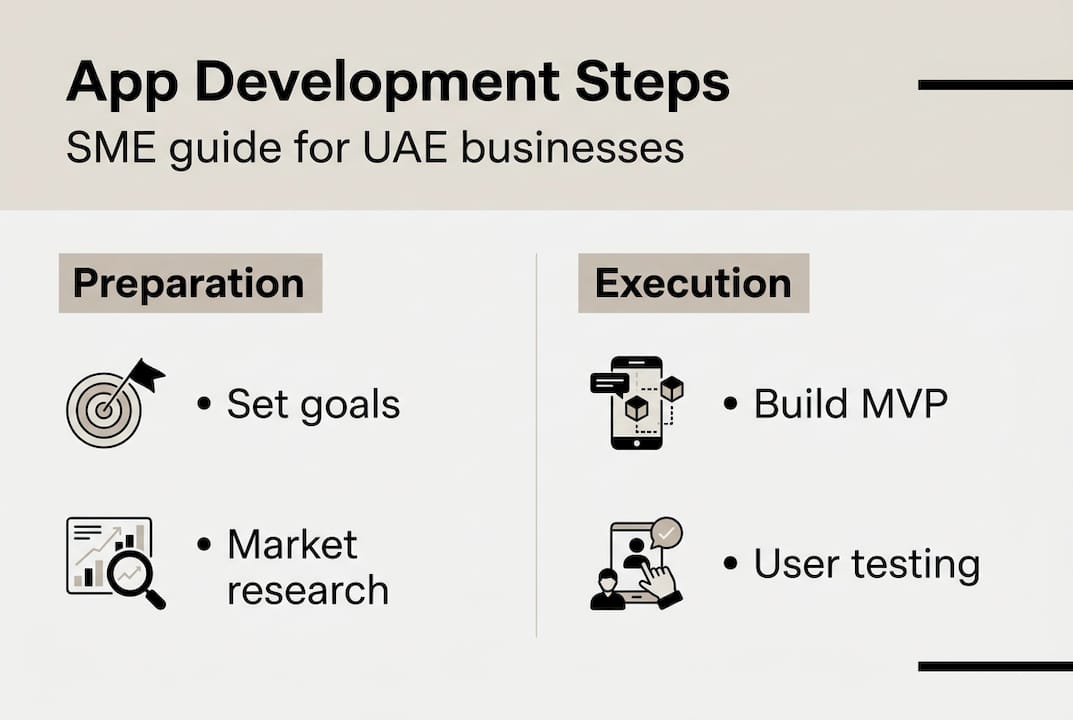
Testing and launch includes QA, usability testing, localization checks, app store deployment, and ASO. Each of these steps is non-negotiable for a UAE market release.
Device fragmentation is a real challenge in the UAE. Your users are running everything from flagship iPhones to mid-range Android devices. Test on at least 8 to 10 device types, covering different screen sizes and operating system versions. Also run localization checks specifically on Arabic text rendering, date formats, and currency display.
Your app store listing is your first marketing asset. App Store Optimization (ASO) means writing keyword-rich titles and descriptions in both Arabic and English, selecting the right category, and using high-quality screenshots that show real app screens. A well-optimized listing can double your organic downloads without any paid spend.
Here’s a practical launch checklist:
- Complete QA testing across all target devices
- Run localization review with a native Arabic speaker
- Submit to both Apple App Store and Google Play with bilingual listings
- Set up analytics tracking (Firebase or equivalent) before launch
- Prepare a soft launch to a limited user group first
- Monitor crash reports within the first 48 hours post-launch
Strong success metrics to track include a Day 7 retention rate of 28%, a crash-free rate of 99.7%, push notification engagement, and personalization performance. These benchmarks tell you whether your app is genuinely retaining users or just getting installed and forgotten.
Invest in app store optimization from day one, and revisit your mobile app UX Dubai strategy based on real user behavior data after launch.
Maintaining and growing your app after launch
With your app live, the work isn’t over. Ongoing improvement and support keep your app competitive and compliant in the UAE.
Most UAE SMEs underestimate what happens after launch. Users expect regular updates. If your app feels stale or starts showing bugs that go unfixed, they uninstall it and leave a negative review. That review then suppresses your app store ranking and discourages new downloads.
Analytics are your guide to smart updates. Track which features users actually use, where they drop off, and which screens generate the most support requests. This data tells you exactly where to invest your next development sprint.
Compliance doesn’t stand still either. UAE data protection regulations and cybersecurity standards evolve, and your app needs to keep pace. Schedule a compliance review every six months to check that your data handling, storage practices, and third-party integrations still meet current PDPL requirements.
Budget for ongoing maintenance from the start. Post-launch maintenance typically costs 15 to 20% of your initial development budget annually, covering updates, bug fixes, and server costs.
Key post-launch priorities for UAE SMEs:
- Monitor retention and engagement metrics weekly for the first three months
- Release at least one meaningful update per quarter to signal active development
- Respond to all app store reviews, especially negative ones, within 48 hours
- Keep third-party SDKs and payment gateway integrations updated
- Review compliance requirements every six months
Explore long-term app support options early so you have a plan in place before issues arise rather than scrambling after them.
What most UAE SMEs get wrong about mobile app development
Despite following common steps, many local app projects go off track. Here’s where most SMEs stumble and how to overcome those traps.
The most expensive mistake we see is copying a big-brand app feature list without the budget or user base to support it. A regional retail giant can afford a loyalty program, AR try-on feature, and live chat because they have millions of users. An SME with 5,000 customers does not need any of that in version one. Overbuilding is how SMEs burn through budgets and launch late, if they launch at all.
Localization is consistently underestimated. Many teams treat Arabic support as a translation task, but it’s actually a design and engineering challenge. Right-to-left layouts, culturally appropriate imagery, and locally relevant content all require deliberate effort. UAE SME app challenges consistently include localization gaps, compliance oversights, and underestimated maintenance costs.
The fix is simple but requires discipline: commit to an MVP, build localization in from day one, and set aside a realistic maintenance budget before you start. Get expert app development guidance that reflects actual UAE market conditions, not generic global frameworks.
Need a trusted partner for mobile app development in Dubai?
If you’re considering launching or improving a mobile app, expert guidance helps maximize results and avoid the common missteps covered in this guide.
At DubaiWebCity, our team of Dubai mobile app specialists has spent over 20 years helping UAE businesses build digital products that actually perform. We handle everything from strategy and UI/UX agency Dubai design to bilingual development, local payment integration, PDPL compliance, and post-launch support. Whether you’re starting from scratch or rescuing a stalled project, we bring the local knowledge and technical depth your app needs. Explore our full SME app guide or reach out to discuss your specific goals with our team.
Frequently asked questions
How long does it take to build a mobile app for an SME in the UAE?
Most SME apps in the UAE take 3 to 6 months depending on scope, features, and MVP complexity. A focused MVP with clear requirements moves significantly faster than a feature-heavy build.
Which mobile app frameworks are best for UAE localization?
Flutter and React Native are the top choices because both support bilingual UI with right-to-left Arabic layouts and integrate well with local payment gateways.
How can UAE SMEs ensure their app meets legal compliance?
Follow the UAE’s PDPL, use local or compliant hosting, and integrate approved payment gateways like Telr and PayTabs from the start of development.
What does it cost to maintain a mobile app after launch?
Annual maintenance typically runs 15 to 20% of your initial development budget, covering updates, security patches, and ongoing compliance requirements.
Recommended
- Mobile app development guide for Dubai SMEs 2026
- What is mobile app UX: a guide for Dubai SMEs in 2026 – Web Design Dubai – Website Design Company Dubai | NetSoft
- IOS App Development in Dubai – Web Design Dubai – Website Design Company Dubai | NetSoft
- Mobile Application Development in Dubai – Web Design Dubai – Website Design Company Dubai | NetSoft