TL;DR:
- 92% of UAE SMEs now accept digital payments and are optimistic about digital growth.
- Digital transformation boosts SME productivity by 25-40% and ROI by 200-500%.
- Barriers include skills gaps, costs, cybersecurity, and regulatory complexity, but government support is expanding.
An astonishing 92% of UAE SMEs now accept digital payments, and 91% feel optimistic about their digital future. That is not a large-enterprise story. That is your market moving fast, and the businesses catching up are already seeing real results. This article cuts through the noise around digital transformation and shows UAE small and medium-sized businesses exactly what the opportunity looks like, how to measure the return, where most companies stumble, and what practical steps you can take starting today. No jargon, no vague advice.
Table of Contents
- The digital transformation landscape for UAE SMEs
- How digital solutions deliver measurable ROI for UAE businesses
- Digital maturity: Levels, pathways, and common pitfalls
- Overcoming barriers: Challenges and strategic solutions for UAE SMEs
- First steps: A phased action plan for digital transformation
- Our take: Rethinking digital transformation beyond the buzzwords
- Ready to accelerate your UAE business? Explore digital solutions that deliver results
- Frequently asked questions
Key Takeaways
| Point | Details |
|---|---|
| Digital transformation ROI | UAE SMEs see up to 40% productivity gains and up to 500% ROI from digital adoption. |
| Phased approach is key | Following a structured, step-by-step digital plan ensures sustainable growth for businesses. |
| Government support available | SMEs in the UAE can access funding and programs to overcome digitalization obstacles. |
| Start with small wins | Launching with foundational tools like e-payments or CRM leads to fast, measurable results. |
The digital transformation landscape for UAE SMEs
Digital transformation sounds like a buzzword, but for UAE SMEs it has a very specific meaning. It is the shift from manual, paper-based, or siloed processes to connected digital tools that run faster, cost less, and give you real-time visibility into your business. That includes enterprise resource planning (ERP) systems, e-payment platforms, cloud-based accounting, customer relationship management (CRM) tools, and professional web services.
The UAE is one of the most digitally progressive markets in the world, and the government is actively funding that momentum. The National Agenda for Entrepreneurship and SMEs channels dedicated investment and policy support toward helping smaller businesses modernize. This is not passive encouragement. It is structured funding, regulatory modernization, and ecosystem building designed to reduce the friction of going digital.
Several forces are pushing SMEs to act now:
- Cashless economy push: The UAE Central Bank’s national payments strategy is accelerating the move away from cash, making e-payment infrastructure a baseline expectation.
- Customer expectations: Buyers now expect seamless online experiences, instant confirmations, and mobile-first interfaces regardless of business size.
- Regulatory modernization: Government portals, licensing systems, and compliance tools are increasingly digital-first, meaning businesses that lag behind face operational friction.
- Competitive pressure: As more local SMEs invest in digital success in Dubai, the gap between digital and non-digital businesses widens quickly.
“The UAE’s digital economy is projected to contribute 19.4% of GDP by 2031, and SMEs are central to that ambition.” This is not background noise. It is the operating environment your business competes in every day.
Understanding Dubai web technology trends helps you see where the market is heading, not just where it is today. Legacy systems built on spreadsheets and manual approvals are not just inefficient. They are becoming a competitive liability.
How digital solutions deliver measurable ROI for UAE businesses
Let’s get specific about money. Digital transformation delivers 25 to 40% productivity gains and 200 to 500% ROI for UAE SMEs, with measurable improvements across operations, customer retention, and revenue stability. Those are not projections. They reflect what businesses in this market are actually experiencing.

Here is a snapshot of what that looks like across common business functions:
| Business area | Before digital | After digital | Typical improvement |
|---|---|---|---|
| Inventory management | Manual counts, frequent errors | Real-time tracking, automated alerts | 30% reduction in overstock |
| Payment processing | Cash or manual invoicing | Automated e-payments, instant reconciliation | 40% faster cash flow |
| Customer communication | Phone and email only | CRM, WhatsApp automation, email sequences | 25% higher retention |
| Reporting and analytics | Weekly spreadsheets | Live dashboards, instant insights | 50% faster decisions |
The SME Confidence Index from Mastercard shows that 92% of UAE SMEs accepting digital payments correlates directly with stronger business confidence and growth outlook. Payment automation alone removes a significant administrative burden and reduces the risk of human error in reconciliation.
Key stat: Businesses that invest in a professional web presence alongside operational tools see compounding returns because online visibility drives inbound leads while back-end tools convert them efficiently.
Understanding digital marketing basics UAE businesses rely on helps you connect the front-end customer experience to the operational systems behind it. And if you are still unsure whether a website justifies the spend, the website development ROI data for Dubai SMBs makes a compelling case.
Pro Tip: Start tracking one operational metric before and after any digital tool you implement. Even a simple before-and-after comparison of invoice processing time builds the internal business case for your next investment.
Digital maturity: Levels, pathways, and common pitfalls
Not every business starts from the same place. Digital maturity describes how deeply technology is embedded in your operations, and understanding your current level helps you prioritize the right next steps.
Most UAE SMEs sit at Level 2 or 3, using basic tools but without full integration. The highest returns come at Level 4, where systems talk to each other and decisions are driven by real-time data.
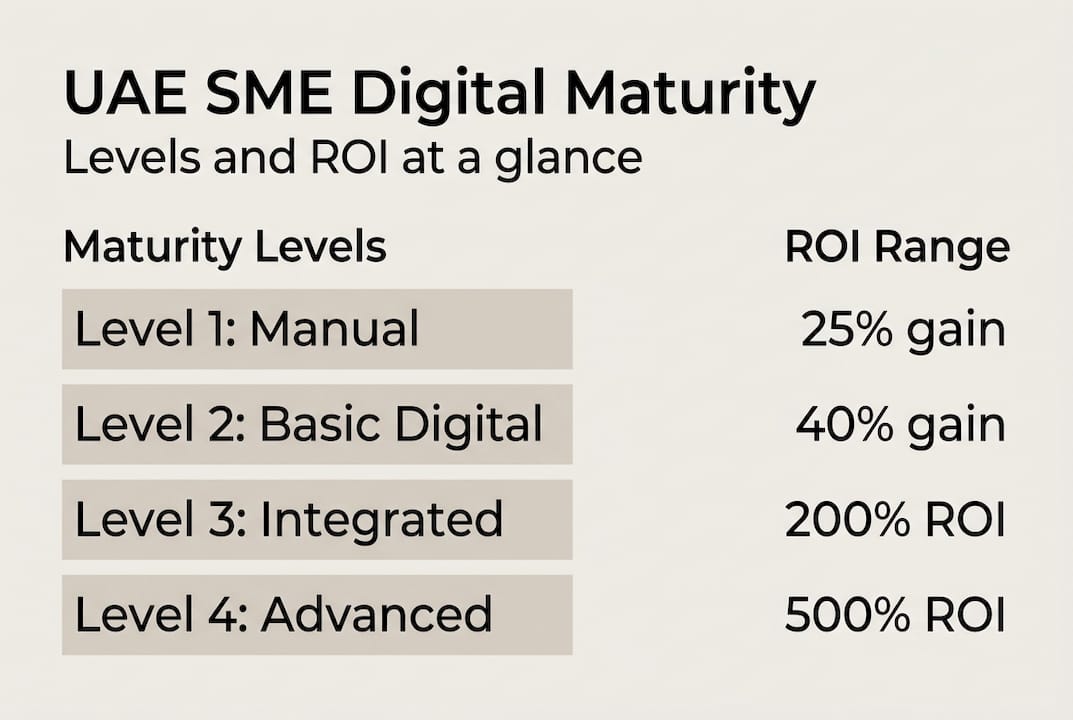
| Level | Description | Typical tools | Key gap |
|---|---|---|---|
| Level 1 | Analog | Paper, phone, cash | No digital infrastructure |
| Level 2 | Basic digital | Email, basic website, manual payments | No integration |
| Level 3 | Operational tools | CRM, accounting software, e-payments | Siloed systems |
| Level 4 | Integrated and automated | ERP, live analytics, full automation | Continuous optimization |
To assess where you stand, work through these steps:
- List every tool your team uses daily, from email to accounting software.
- Identify where data is entered manually more than once.
- Note where delays or errors most often occur.
- Ask which decisions you make without reliable data.
- Check whether your customer-facing experience matches what your competitors offer online.
Common pitfalls UAE SMEs hit during this process include underestimating integration complexity, skipping staff training, and automating broken processes instead of fixing them first. A business that automates a flawed invoicing workflow just creates faster errors.
Quick wins like a professional website, a CRM, and e-payment tools can be implemented in weeks. Long-term strategy involves connecting those tools so data flows without manual input. Reviewing website essentials Dubai SMBs need in 2026 is a practical starting point for the customer-facing layer. And understanding the role of digital marketing in UAE business growth helps you see how visibility and operations reinforce each other.
Pro Tip: If your team is manually re-entering data between two systems, that is your clearest signal that you are stuck at Level 2 or 3. Integration, not more tools, is your priority.
Overcoming barriers: Challenges and strategic solutions for UAE SMEs
Knowing the opportunity and knowing the path forward does not make the obstacles disappear. UAE SMEs face real barriers, and pretending otherwise helps no one. The most common challenges are:
- Digital skills gaps: Many teams lack the technical knowledge to evaluate, implement, or maintain new tools without external support.
- Budget constraints: Upfront costs for software licenses, integration work, and training can feel prohibitive for smaller businesses.
- Cybersecurity concerns: As more operations move online, the risk of data breaches and fraud increases, particularly for businesses handling customer payment data.
- Regulatory complexity: Navigating UAE data protection laws, VAT compliance systems, and sector-specific regulations adds layers of complexity to any digital project.
Research on UAE SME digital transformation confirms that financial constraints, skills shortages, and cybersecurity top the list of barriers, but also notes that government support is expanding rapidly to address each one.
“The UAE’s fintech sandbox programs, upskilling initiatives through entities like the Mohammed Bin Rashid Innovation Fund, and SME-specific digital grants represent a growing ecosystem of practical support that most business owners have not fully explored.”
A phased approach helps manage cost and risk. Rather than attempting a full digital overhaul at once, start with the tools that address your most painful operational problem. Then build from there. The SME digital marketing checklist for Dubai businesses gives you a structured way to audit your current digital presence before spending anything. And if customer communication is your biggest gap, exploring WhatsApp integration for your business is a low-cost, high-impact starting point given how widely the platform is used in the UAE market.
First steps: A phased action plan for digital transformation
A phased methodology is the most reliable approach for UAE SMEs: assess your current state, define clear goals, capture quick wins, integrate with government systems, automate, and then measure ROI before the next phase.
Here is how to put that into practice:
- Assess your digital maturity. Use the four-level framework above to identify your starting point. Be honest about where manual processes are slowing you down.
- Set measurable goals. Vague goals like “go more digital” fail. Specific goals like “reduce invoice processing time by 30% within 90 days” give you something to track.
- Start with foundational tools. A professional website, an e-payment solution, and a basic CRM form the core of any SME’s digital foundation. These three alone can transform your customer experience.
- Connect with UAE government digital services. Platforms like the Dubai SME portal and federal e-government services offer resources, grants, and compliance tools that reduce your implementation cost.
- Automate and optimize. Once your foundational tools are running, look for repetitive tasks that can be automated. Email follow-ups, payment reminders, and inventory alerts are common starting points.
- Measure and iterate. Review your metrics every 30 days for the first quarter. Adjust based on what the data shows, not what you assumed would happen.
If mobile is a priority for your customers, the SME app development guide for Dubai businesses walks through when an app makes sense versus a mobile-optimized website. And if you are ready to move forward, reviewing the app development steps UAE SMEs follow helps you understand what the process actually involves before you commit.
Pro Tip: Assign one internal owner for each digital tool you implement. Tools without owners get abandoned within three months. Accountability is the difference between a successful rollout and shelfware.
Our take: Rethinking digital transformation beyond the buzzwords
After working with UAE businesses across dozens of industries since 2004, here is what we have seen consistently: most SMEs mistake buying tools for doing transformation. They purchase software, run a brief training session, and expect results. When the results are slow, they blame the tool. The tool is rarely the problem.
Real digital transformation success comes from three things that no software vendor will tell you upfront. First, integration matters more than individual tools. A great CRM that does not connect to your website or payment system creates more work, not less. Second, user experience inside your business is just as important as the customer-facing experience. If your team finds a tool confusing, they will work around it. Third, shiny object syndrome is real. We have watched businesses chase AI dashboards and blockchain integrations while their website was broken on mobile and their checkout process had a 70% abandonment rate. Fix the fundamentals before chasing the frontier. The UAE market rewards businesses that execute well on the basics, not those that adopt the most tools.
Ready to accelerate your UAE business? Explore digital solutions that deliver results
Your website is the anchor of your entire digital presence. Every ad you run, every social post you share, and every referral you receive lands on it. If it is slow, outdated, or hard to navigate on mobile, you are losing business before the conversation even starts.
At DubaiWebCity, we have spent over 20 years helping UAE businesses build digital foundations that actually perform. Whether you need creative web design ideas that reflect your brand, a fully responsive web design Dubai businesses rely on, or a custom mobile app development Dubai solution built for your market, we tailor every project to your specific goals. Let us show you what a well-built digital presence can do for your revenue.
Frequently asked questions
What qualifies as digital solutions for SMEs in the UAE?
Digital payments and ERP systems are among the most common elements, but digital solutions also include cloud software, CRM platforms, mobile apps, and professional web services used to automate and connect business operations.
How fast can UAE businesses see ROI from digital transformation?
Most UAE SMEs report ROI within the first year, with 25 to 40% productivity gains and returns of 200 to 500% documented across operational and revenue improvements.
What are the main obstacles to digital transformation for SMEs?
Financial constraints, skills gaps, and cybersecurity top the list of barriers for UAE SMEs, alongside regulatory complexity that requires careful planning before implementation.
Does the UAE government offer support for SME digital adoption?
Yes. The National Agenda for Entrepreneurship and SMEs provides dedicated funding, policy frameworks, and ecosystem support specifically designed to accelerate digital transformation for smaller businesses.
Recommended
- Master digital marketing basics for UAE SME success – Web Design Dubai – Website Design Company Dubai | NetSoft
- Digital marketing checklist for Dubai SMEs: boost local growth
- Digital marketing role in UAE business growth 2026
- Business website essentials for Dubai SMBs in 2026 – Web Design Dubai – Website Design Company Dubai | NetSoft