TL;DR:
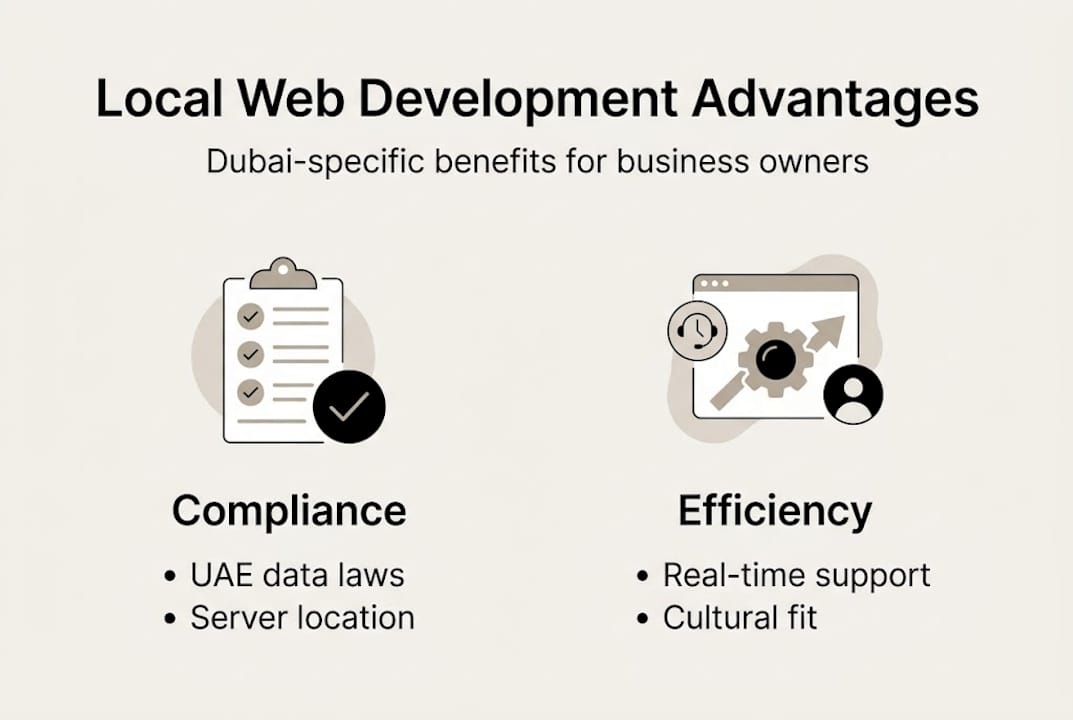
- Local Dubai web developers ensure compliance with UAE data laws and regional regulations from the start.
- Working with local teams provides real-time communication, faster feedback, and project efficiency.
- Culturally relevant design, bilingual interfaces, and regional payment options improve user engagement and trust.
Most Dubai SMB owners assume the main reason to choose a local web developer over an offshore team is cost. But that framing misses the real story entirely. For businesses operating in Dubai’s regulated, multicultural, and fast-moving market, factors like legal compliance, real-time communication, and cultural relevance carry far more weight than the invoice total. This article breaks down exactly why local web development delivers value that offshore teams genuinely struggle to replicate, covering everything from UAE data laws and Arabic-English design to post-launch accountability. If you’re deciding where to invest your digital budget, this is what you need to understand first.
Table of Contents
- Local compliance and legal peace of mind
- Seamless communication and project efficiency
- Cultural relevance and effective user experience
- Trust, accountability, and ongoing support
- Why Dubai SMBs should rethink the ‘lowest price wins’ mindset
- Take the next step with Dubai’s trusted local web experts
- Frequently asked questions
Key Takeaways
| Point | Details |
|---|---|
| Regulatory peace of mind | Choosing a local developer ensures your website meets all Dubai and UAE digital laws, avoiding compliance risks. |
| Faster, clearer collaboration | Local teams enable real-time communication and efficient project management without time zone delays. |
| Cultural and user experience fit | Web solutions are tailored to Dubai’s unique audience, supporting bilingual content and regional standards. |
| Reliable support and trust | Having a partner nearby builds trust and provides direct, ongoing assistance when you need it most. |
Local compliance and legal peace of mind
Dubai’s digital landscape comes with a rulebook that most offshore developers simply haven’t read. The UAE’s Personal Data Protection Law (PDPL), the DIFC Data Protection Law, and the ADGM Data Protection Regulations each carry specific obligations for any website collecting user data. Fail to meet them and you risk fines, forced site takedowns, or reputational damage that can be very hard to recover from.
Local web developers who work inside the UAE market build these requirements into every project from day one. They understand when you need a Data Protection Officer (DPO), when a Data Protection Impact Assessment (DPIA) is triggered, and how to implement consent mechanisms that actually satisfy UAE regulators, not just generic European GDPR standards. As UAE data compliance laws outline, compliance with UAE PDPL, DIFC/ADGM frameworks, and federal cybersecurity regulations is significantly easier when local developers manage it from the build stage.
Here’s what local compliance expertise typically covers for Dubai SMBs:
- Consent management: Proper opt-in flows built to UAE regulatory standards
- Data localization: Ensuring user data is stored on UAE-based or approved servers
- Privacy policy language: Bilingual and legally accurate for both English and Arabic audiences
- Cybersecurity requirements: Integration with UAE National Cybersecurity Authority (NCA) guidelines
- Free zone-specific rules: DIFC and ADGM have their own data governance layers that mainland rules don’t cover
“Offshore teams often apply a one-size-fits-all GDPR approach, but Dubai’s regulatory environment has distinct layers that require genuine local knowledge to navigate correctly.”
For businesses operating in DIFC or ADGM free zones, this matters even more. These jurisdictions run on English common law and maintain separate data protection frameworks from the UAE mainland. A developer unfamiliar with this split will either over-engineer your compliance setup or miss critical requirements entirely.
Data sovereignty is another key point. Hosting your website on local servers, or on approved cloud infrastructure within the UAE, is increasingly important for regulated industries like healthcare, finance, and legal services. UAE-compliant hosting options designed for Dubai businesses already account for these requirements, saving you the back-and-forth of retrofitting compliance after launch.
Pro Tip: Before signing any web development contract, ask your developer directly whether they have experience with UAE PDPL compliance and DIFC/ADGM data requirements. A blank stare is a red flag you can’t afford to ignore.
Seamless communication and project efficiency
Time zones sound like a minor inconvenience until you’re waiting 16 hours for a response on a launch-day bug. For Dubai SMBs with tight timelines and real revenue on the line, offshore communication delays are not a small problem. They compound.
Real-time collaboration advantages are one of the clearest benefits local teams provide, eliminating time zone friction and enabling the kind of rapid iteration that keeps projects on schedule and on budget. When your developer is two kilometers away instead of two continents away, a feedback loop that would take three days offshore wraps up in three hours.
| Factor | Local Dubai team | Offshore team |
|---|---|---|
| Response time | Same business hours | 8-16 hour delay |
| Meeting flexibility | In-person or same-timezone video | Scheduling across time zones |
| Feedback iteration | Same-day turnaround | 1-3 day cycles |
| Cultural alignment | Built-in | Needs extensive briefing |
| Emergency support | Immediate | Overnight wait |
A typical local web project runs through a cleaner cycle because of this proximity:
- Kickoff meeting: You sit down together, in Dubai, and align on goals, brand tone, and technical requirements with no cultural translation needed.
- Design feedback: You review mockups and respond in real time, cutting revision rounds from weeks to days.
- Content iteration: Arabic and English copy gets refined collaboratively without long email threads.
- Testing phase: Bugs get flagged and fixed within hours, not flagged and queued overnight.
- Launch: Your team and your developer are awake at the same time, ready to handle anything that comes up on go-live day.
Cultural alignment also plays a role in communication efficiency. When choosing creative web developers in Dubai, local agencies already understand the professional culture, expected response etiquette, and the importance of relationship-building in UAE business contexts. For ongoing projects, this matters enormously.
Pro Tip: Request weekly status calls during development and insist on a dedicated local project manager. Accountability is dramatically easier when both parties are operating in the same business day.
CMS website management platforms built by local teams also tend to be handed over with proper training in your timezone, so your internal staff can manage updates without waiting for offshore support tickets to cycle through.
Cultural relevance and effective user experience
A website built for Dubai’s market needs to do more than look good on a laptop screen. It needs to feel right to your customers, and that requires a level of local insight that most offshore teams simply don’t have.
Consider the basics. Dubai’s online audience expects bilingual interfaces, and Arabic is not just a translation layer. It’s a right-to-left layout, different typographic conventions, and a distinct set of design preferences around color, imagery, and spacing. Get any of these wrong and you immediately signal to a significant portion of your audience that you don’t quite understand them.

| Design element | Local developer approach | Generic offshore approach |
|---|---|---|
| Language | Full Arabic/English bilingual | English-only or poor translation |
| Layout | RTL-compatible design | LTR defaults with patches |
| Payment gateways | Telr, PayTabs, Payfort integration | Generic Stripe or PayPal |
| Seasonal content | Ramadan, National Day campaigns | Generic seasonal templates |
| Mobile optimization | UAE mobile usage patterns | Generic global benchmarks |
Local developers also understand what drives engagement in this market:
- Payment gateways: Integrating UAE-preferred options like Telr and PayTabs instead of international-only solutions that many local bank cards don’t support
- Mobile-first design: With mobile internet penetration in the UAE among the highest globally, local teams build mobile experiences around actual regional behavior patterns
- Event-aware content: Ramadan promotions, UAE National Day campaigns, and Dubai Shopping Festival landing pages are second nature to local developers
- Visual culture: Color associations, imagery preferences, and design aesthetics differ meaningfully across Arabic and Western audiences
“Cultural fit isn’t a soft benefit. It directly affects bounce rates, conversion rates, and how long users stay on your site.”
For Dubai SMBs competing in retail, hospitality, real estate, or professional services, these details are the difference between a website that generates leads and one that just exists. Working with leading Dubai web developers who build for this audience every day compresses what would otherwise be a steep learning curve for any offshore team.
Trust, accountability, and ongoing support
Building a website isn’t a one-time transaction. It’s the beginning of an ongoing relationship that will involve updates, security patches, feature additions, and the occasional urgent fix when something breaks at the worst possible moment.
Local developers bring a layer of accountability that remote teams can’t easily replicate. You can walk into their office. You can escalate through a real chain of command. You can build a relationship over coffee and check in on your project without filing a support ticket and waiting for a response from a different hemisphere.
Local web agencies provide SMBs with the direct accountability, ongoing maintenance, and post-launch support that Dubai’s regulated and competitive market specifically demands.
Here’s what strong post-launch support looks like from a local Dubai developer:
- Guaranteed response times: A clear SLA (Service Level Agreement) with response windows measured in hours, not business days across time zones.
- Regular maintenance packages: Monthly security updates, plugin management, and performance checks handled proactively rather than reactively.
- Training and handover: Your team gets trained in person on how to manage content, update listings, or add new pages without calling for help every time.
Three signs that a local developer genuinely values post-launch support:
- They include a maintenance period in their standard contract, not as an upsell
- They offer a local emergency contact number, not just a ticket system
- They proactively flag issues before they become problems
Pro Tip: Ask any prospective developer for two or three client references specifically from businesses they’ve supported post-launch. How a team handles life after go-live tells you more than any portfolio piece.
For cost-effective local partners in Dubai, ongoing support is baked into the value proposition, not treated as optional.
Why Dubai SMBs should rethink the ‘lowest price wins’ mindset
We’ve seen this pattern play out more times than we can count. A Dubai SMB chooses an offshore team based on a quote that looks great on paper. The project drags. Compliance gaps appear after launch. The cultural fit is off. Support goes quiet after the invoice clears. Six months later, the business is rebuilding its website from scratch with a local team anyway, having spent more in total than if they’d started locally.
Offshore development can be a viable choice for simpler projects where cost is the only constraint. But for Dubai businesses operating in regulated sectors or serving multicultural audiences, the calculus shifts fast. Speed, compliance, and trust are not premium features. They are baseline requirements.
The businesses we see thrive long-term in Dubai’s market are the ones that treat their website as a business-critical asset and fund it accordingly. They work with trusted Dubai developers who know their regulatory environment, speak their customers’ language literally and culturally, and show up when things go wrong. That’s not a luxury calculation. It’s a risk management one.
Take the next step with Dubai’s trusted local web experts
Understanding the advantages of local web development is one thing. Putting them to work for your business is another. At DubaiWebCity, we’ve spent over 20 years building websites specifically for Dubai’s market, handling everything from Arabic-English bilingual design to UAE data compliance and post-launch support.
Whether you’re starting fresh or rebuilding an underperforming site, we offer creative Dubai web design, responsive website design built for UAE audiences, and CMS development for Dubai businesses that want to manage their content without technical headaches. Reach out today for a consultation tailored to your business goals and your market.
Frequently asked questions
What regulations must Dubai businesses follow for website compliance?
Dubai businesses must comply with the UAE PDPL and DIFC/ADGM data laws, along with federal cybersecurity regulations that require specific consent mechanisms and local data hosting practices.
How does working with a local Dubai web developer save time?
Local developers eliminate time zone barriers entirely, enabling same-day feedback cycles and real-time collaboration that can cut project timelines significantly compared to offshore teams.
Can offshore web developers deliver the same compliance for Dubai?
Offshore teams often apply generic GDPR frameworks that miss UAE-specific requirements under the PDPL, DIFC, and ADGM, creating compliance gaps that only appear after launch when they’re costlier to fix.
What cultural factors do local Dubai developers consider?
Local developers build bilingual interfaces and culturally relevant design, integrate UAE-preferred payment gateways, and account for regional events like Ramadan and UAE National Day that directly affect user engagement.
Is local web development more expensive than offshore, and is it worth it?
Upfront costs may be higher, but local development in regulated markets like Dubai delivers long-term value through compliance, faster delivery, and dependable support that offshore teams rarely match.
Recommended
- Why choose a local web agency in Dubai for SMB success
- How to choose creative web development company in Dubai – Web Design Dubai – Website Design Company Dubai | NetSoft
- Top Website Development Companies in Dubai – Web Design Dubai – Website Design Company Dubai | NetSoft
- Why choose Dubai web designers for your SME’s success