TL;DR:
- Improving UI/UX increases Dubai SMBs’ conversions by up to 32% through localization and cultural relevance.
- Fast, mobile-responsive, and culturally adapted websites significantly reduce bounce rates and boost engagement.
- Ongoing testing and maintenance of UX deliver high ROI, making user experience a key growth driver.
Poor UI/UX is silently draining revenue from Dubai businesses every single day. Visitors land on a slow, visually confusing site and leave within seconds, taking their wallets with them. The good news is that targeted improvements deliver real, measurable payoffs. Localized UX boosts conversions by 32% for Dubai SMBs that integrate Arabic RTL support, culturally relevant visuals, and personalization. This guide walks you through a clear, practical roadmap from evaluating your current site and localizing for Dubai audiences, to executing fast wins and maintaining momentum for sustainable business growth.
Table of Contents
- Assessing your current UI/UX: What Dubai SMBs must check first
- Localize your UI/UX: Cultural considerations for Dubai audiences
- Step-by-step improvements: Fast wins for UI/UX enhancement
- Testing and maintaining UI/UX: Sustaining results for business growth
- Why UI/UX is your ROI engine: A Dubai business viewpoint
- Unlock better results with Dubai’s leading UI/UX experts
- Frequently asked questions
Key Takeaways
| Point | Details |
|---|---|
| Fast wins matter | Speed and mobile responsiveness are top priorities for Dubai SMB UI/UX improvement. |
| Localization drives results | Arabic support and cultural visuals significantly increase engagement and conversions. |
| Continuous optimization needed | Testing and ongoing refinement are essential for sustaining UI/UX and business growth. |
| UI/UX is ROI-positive | Every dollar spent on UI/UX can yield a massive return for Dubai businesses. |
Assessing your current UI/UX: What Dubai SMBs must check first
Before you fix anything, you need an honest look at what’s actually broken. Think of it as a health check for your digital storefront. Gut feelings don’t cut it here. You need data-backed benchmarks that reflect the expectations of Dubai’s mobile-first, digitally savvy users.
Start with the fundamentals. Check your site’s load speed, visual hierarchy, navigation clarity, and mobile responsiveness. These are the non-negotiables that separate sites that convert from those that bleed traffic. For responsive website checks, run your URL through Google Lighthouse, a free tool that scores performance, accessibility, and best practices in under a minute.
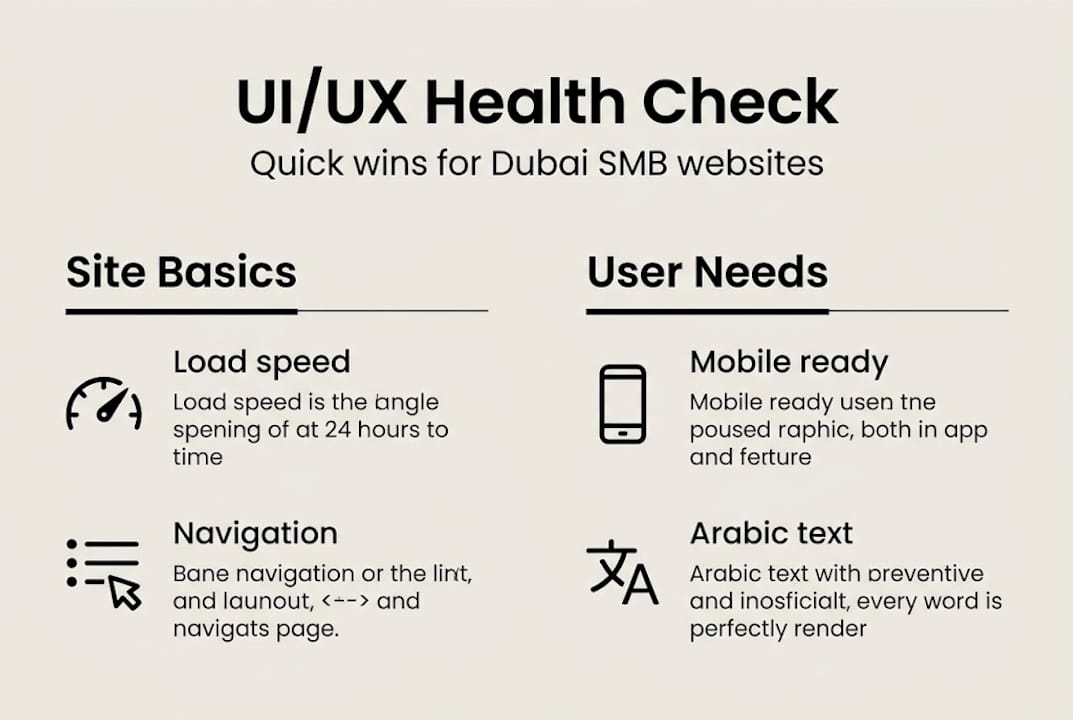
Dubai SMB UI/UX evaluation checklist
| Metric | Benchmark | Why it matters |
|---|---|---|
| Page load time | Under 3 seconds | 53% abandon sites that load slowly |
| Mobile responsiveness | Full support | Majority of UAE traffic is mobile |
| Arabic RTL support | Functional layout | Required for local audience trust |
| Navigation clarity | Max 3 clicks to key pages | Reduces friction and drop-off |
| Cultural imagery | Localized visuals | Boosts relatability and engagement |
| CTA placement | Above the fold | Drives faster user decisions |
Beyond the table, here’s a quick self-audit list to run through right now:
- Does your site load in under 3 seconds on a mobile connection?
- Is your menu intuitive, with no more than 5-7 top-level items?
- Are your call-to-action buttons clearly visible without scrolling?
- Does your design reflect Dubai’s visual culture and trust signals?
- Are contact forms short and easy to complete on a phone screen?
Mobile-first is not a trend in Dubai. It’s the baseline. Reviewing your user experience improvements through both speed and usability lenses gives you a complete starting picture.
Pro Tip: Run Google Lighthouse on both your desktop and mobile versions. The mobile score is often significantly lower, and that’s where most of your Dubai audience actually browses.
Localize your UI/UX: Cultural considerations for Dubai audiences
Once you’ve assessed your current site, prioritize cultural adaptation. A globally generic site is a missed opportunity in Dubai, where users expect experiences that speak their language, literally and visually.
Localization goes far beyond translating your homepage into Arabic. It means rethinking your entire interface to reflect local preferences, norms, and expectations. Here’s what a truly localized Dubai UX must include:
- Arabic RTL (right-to-left) layout that mirrors how Arabic readers naturally scan content
- Localized imagery featuring people, places, and scenarios familiar to UAE residents
- Local payment options including Tabby, Tamara, and regional card processors
- Culturally appropriate tone that balances formality with warmth, avoiding Western idioms
- Prayer time and local calendar awareness in scheduling or booking tools
- Trust signals such as UAE trade license numbers and local phone numbers
The data backs this up clearly. Localized UX reduces bounce rates and boosts conversions by 32% for Dubai businesses. And it’s not just about conversions. Adobe research shows that 38% of users will stop engaging with a site if the layout or content is unattractive, making visual and cultural relevance a business-critical concern.
Standard vs. localized Dubai UI/UX
| Feature | Standard global UI/UX | Localized Dubai UI/UX |
|---|---|---|
| Language | English only | English plus Arabic RTL |
| Imagery | Stock Western photos | UAE-relevant local visuals |
| Payment | Global cards only | Tabby, Tamara, UAE processors |
| Content tone | Generic Western style | Culturally warm and formal |
| Trust elements | Generic reviews | Local license, local contacts |
Boosting engagement through design means closing the gap between what your site assumes about visitors and what those visitors actually expect. Poor localization doesn’t just hurt conversions. It signals that your brand doesn’t understand its own market. For deeper context on how customer experience transformation drives business outcomes, the connection between cultural fit and loyalty is clear. Review local UX case studies to see how Dubai businesses have navigated this effectively.
Step-by-step improvements: Fast wins for UI/UX enhancement
With localization set, you can now implement tactical UI/UX changes that produce visible results quickly. These steps are ordered by impact, so you get the most value from your first actions.
- Optimize page speed. Compress images, enable browser caching, and use a content delivery network. Every second shaved off load time matters because 53% of mobile users leave before a slow page finishes loading.
- Simplify navigation. Reduce your menu to the most essential pages. Use clear, descriptive labels. Dropdown overload kills usability on mobile screens.
- Improve mobile responsiveness. Test every page on multiple screen sizes. Buttons, forms, and text must all function flawlessly on a phone.
- Refresh your visuals. Swap outdated or generic stock photos for imagery that resonates with a Dubai audience. Authentic visuals build trust faster than words.
- Enable Arabic language support. Add a fully functional Arabic version with proper RTL formatting. A toggled translation plugin is not enough. Real RTL design requires a layout rebuild.
- Streamline your forms. Cut every unnecessary field. For lead generation forms, three to five fields is the sweet spot. For checkout, fewer steps mean fewer abandoned carts.
- Add trust signals. Display your trade license, client logos, security badges, and UAE-based contact details prominently.
A properly executed landing page design follows all of these principles in one focused experience. If budget is a concern, check our website redesign cost guide to plan realistically.
Pro Tip: Speed and mobile responsiveness deliver the fastest ROI. Fix those first before tackling visual or content updates. A beautiful site that loads slowly still loses visitors.
A UX redesign boosts conversions by 32% on average, which makes even modest changes worth prioritizing over other marketing spend. AI personalization and biometric login options are emerging as additional engagement drivers in Dubai’s tech-forward market, worth planning for in your next update cycle.
Testing and maintaining UI/UX: Sustaining results for business growth
After implementing UI/UX improvements, the work doesn’t stop. Testing and maintenance are where your gains compound over time.
Start with usability testing. Ask 5 to 8 real users, ideally a mix of Arabic and English speakers, to complete core tasks on your site. Watch where they hesitate, click the wrong thing, or give up. These sessions reveal friction that analytics alone can’t explain. Combine this with short post-visit surveys to capture qualitative feedback.
For ongoing measurement, track these core UX KPIs:
- Bounce rate: Are visitors staying or leaving immediately?
- Time on page: Are users actually reading your content?
- Form completion rate: How many users start vs. finish your forms?
- Conversion rate: Is traffic actually turning into leads or sales?
- Core Web Vitals scores: Google’s own measure of real-world user experience
Before-and-after UX improvement benchmarks
| KPI | Typical before | Target after improvement |
|---|---|---|
| Bounce rate | 65-75% | Below 45% |
| Page load time | 5-8 seconds | Under 3 seconds |
| Mobile conversion rate | 1-2% | 3-5% |
| Form completion rate | 20-30% | 50-65% |
| Time on page | Under 1 minute | 2-3 minutes |
The return on this sustained effort is significant. A Forrester study shows that every $1 invested in UX returns $100, a 9,900% ROI that makes UX maintenance one of the highest-yielding business activities you can run. Explore expert web development tips and website tech solutions to support your ongoing optimization. For broader context on how user experience shapes digital leaders, the pattern is consistent: sustained attention to UX separates growing businesses from stagnant ones.
Why UI/UX is your ROI engine: A Dubai business viewpoint
Here’s an uncomfortable truth most Dubai SMBs don’t want to hear. They’re still treating UI/UX as a cosmetic exercise, something you do when you redesign the site every five years. That’s the wrong mental model entirely.
Effective UI/UX is a business multiplier. It amplifies every other investment you make, from SEO to paid advertising to social media. A better user experience means lower bounce rates, which means Google ranks you higher. That’s free organic traffic you’d otherwise pay for.
The businesses pulling ahead in Dubai aren’t the ones with the flashiest designs. They’re the ones whose sites are fast, intuitive, culturally relevant, and relentlessly user-tested. The real-world impact of this approach shows up in every metric that matters.
Quick wins are a starting point, not a destination. The SMBs that see sustained growth are those that build UX review cycles into their operations, the same way they review financials. It’s less about aesthetics and more about cultural fit, usability, and trust. Get those right, and the revenue follows.
Unlock better results with Dubai’s leading UI/UX experts
Ready to move from self-auditing to real transformation? Expert support accelerates every stage of the process, from technical audits to full redesigns built specifically for Dubai’s market.
At DubaiWebCity, we’ve spent over 20 years helping Dubai businesses build websites that perform, not just look good. Our team handles creative web design ideas, full responsive UI/UX services, and a strategic design thinking approach that connects your brand to the right audience. Whether you need Arabic RTL integration, a mobile-first overhaul, or an ongoing optimization partner, we’re here to make it happen. Reach out today and let’s build something that genuinely works for your business.
Frequently asked questions
What are the quickest ways to improve UI/UX for my Dubai SMB website?
The fastest wins are speeding up your site, ensuring mobile responsiveness, and enabling Arabic RTL support. 53% of users abandon slow-loading sites, so speed alone can recover significant lost traffic.
How do I measure the ROI of UI/UX changes?
Track conversion rates, bounce rates, and form completion before and after changes using analytics tools. Research shows that a $1 UX investment returns $100, making it one of the most measurable business improvements available.
Why is localization (Arabic, cultural content) so important for Dubai SMB websites?
Localized UI/UX builds immediate trust with Dubai users and speaks to their actual expectations. Localized UX boosts conversions by 32%, making it one of the highest-impact changes a Dubai business can make.
How often should I update or re-evaluate my website’s UI/UX?
Review usability and key KPIs every 6 to 12 months or whenever your business undergoes significant changes, such as a new service offering or major audience shift.
Does UI/UX affect search engine rankings for Dubai businesses?
Yes, improved UI/UX lowers bounce rates and improves Core Web Vitals scores, both of which Google factors into rankings, giving your Dubai site a measurable SEO advantage.