
Expanding your retail business online in Dubai is rarely straightforward. The market is shaped by high mobile and internet penetration, and consumer expectations for seamless digital experiences are rising fast. If you want your e-commerce platform to thrive, you need a clear roadmap that aligns with Dubai’s unique requirements. This guide delivers actionable steps for defining precise business goals, building a responsive site, integrating secure payments, optimizing for search engines, and verifying every detail before you launch.
Table of Contents
- Step 1: Define Business Goals And Dubai Market Requirements
- Step 2: Design A Custom, Responsive E-Commerce Platform
- Step 3: Integrate Secure Payment And Local Compliance Features
- Step 4: Optimize Site For Seo And Mobile Performance
- Step 5: Verify Site Functionality And Launch For Dubai Audiences
Quick Summary
| Key Takeaway | Explanation |
|---|---|
| 1. Define Clear Goals | Establish specific, measurable objectives based on your e-commerce strategy to guide decisions in Dubai’s competitive market. |
| 2. Choose Platform Wisely | Decide between custom or pre-built e-commerce solutions based on budget, timeline, and functionality needs. |
| 3. Prioritize Security | Implement robust security measures and ensure compliance with local regulations to build customer trust in Dubai. |
| 4. Optimize for Mobile | Enhance mobile performance and site speed to improve search rankings and overall user experience for shoppers. |
| 5. Conduct Comprehensive Testing | Thoroughly test site functionality across devices to prevent errors that could harm customer experience at launch. |
Step 1: Define business goals and Dubai market requirements
Before you build your e-commerce site, you need crystal-clear business goals and a solid understanding of Dubai’s unique market. This foundation shapes every decision you’ll make—from platform choice to product strategy to marketing approach.
Start by defining what success looks like for your business. Are you launching a completely new online channel, or are you expanding an existing retail operation into digital? The answer determines your goals. Your objectives might include reaching a specific revenue target within the first year, capturing a percentage of the online market share, or simply building brand awareness among Dubai’s digitally connected shoppers.
Dubai’s e-commerce environment is incredibly competitive and rapidly evolving. The market has experienced significant growth driven by high internet and mobile penetration, and consumer behaviors have shifted dramatically toward digital shopping. Understanding these dynamics helps you position yourself correctly.
Consider these core business goal categories:
- Revenue targets: Define monthly or annual sales goals and profit margins
- Customer acquisition: Set realistic numbers for new customers per month
- Market position: Identify your target segment and competitive advantage
- Geographic scope: Decide if you’ll serve only Dubai, all of UAE, or the broader GCC region
- Product strategy: Clarify which product categories align with Dubai consumer preferences
Next, research what actually sells in Dubai. Consumer preferences here differ from other markets. Shoppers prioritize competitive pricing and excellent customer service, so your business goals should account for these expectations. The market also values convenience—many consumers expect seamless integration between online services and real-world utilities.
Here’s how Dubai’s e-commerce market aspects impact goal setting:
| Market Aspect | Influence on Goals | Example Consideration |
|---|---|---|
| High competition | Sets higher entry standards | Need unique value proposition |
| Mobile-first shoppers | Demands mobile-ready tactics | Prioritize mobile platform |
| Government support | Creates growth opportunities | Leverage incentive programs |
| Consumer expectations | Shapes service benchmarks | Emphasize fast delivery |
Dubai’s government actively supports e-commerce growth through its strategic initiatives, which aim to reduce business costs and simplify operations. This creates opportunities for well-positioned businesses. Understanding Dubai’s e-commerce strategy helps you align your goals with regional economic priorities and leverage available support programs.
You should also map out your competitive landscape. Who else sells what you’re selling in Dubai? What’s their pricing, customer service, and brand positioning? This competitive analysis directly influences your realistic business goals.
Your business goals must balance ambition with market reality—aim high, but ground your targets in actual Dubai market conditions and consumer behavior data.
Pro tip: Write down your three most important business metrics and assign a specific, measurable target to each. Review these targets monthly as you build your site—they’ll keep you focused on what actually drives success, not vanity metrics like site traffic.
Step 2: Design a custom, responsive e-commerce platform
Your platform design is where your business goals meet customer reality. A well-designed e-commerce site isn’t just visually appealing—it’s a conversion machine that works seamlessly across phones, tablets, and desktops.
Start by choosing between building custom or using a pre-built platform. Custom development gives you complete control over functionality and branding, while platforms like Shopify offer faster setup and built-in features. Your choice depends on your budget, timeline, and technical complexity needs.
Responsive design is non-negotiable. Most Dubai shoppers browse on mobile devices, and your site must adapt flawlessly to every screen size. Responsive design fundamentals directly impact user engagement and conversion rates.

Below is a comparison of custom vs. pre-built e-commerce platforms for the Dubai market:
| Feature | Custom Platform | Pre-built Solution |
|---|---|---|
| Development Speed | Slow, highly tailored | Fast, ready out-of-the-box |
| Upfront Cost | Higher investment | Lower, subscription-based |
| Branding Control | Full customization | Limited adjustments |
| Local Integration | Completely flexible | Pre-integrated options |
Focus on these core design elements:
- Intuitive navigation: Users should find products in three clicks or less
- Fast loading speeds: Every second of delay reduces conversions by measurable amounts
- Mobile optimization: Test extensively on iPhone and Android devices
- Clear product pages: High-quality images, detailed descriptions, and visible pricing
- Simple checkout: Minimize form fields and offer guest checkout options
- Trust signals: Display security badges, customer reviews, and payment options prominently
Personalization matters in Dubai’s competitive market. Use data analytics to show customers products based on their browsing history and preferences. This creates a more engaging experience and increases average order value.
Consider your platform architecture carefully. Whether you build with custom code or use an established e-commerce solution, ensure it integrates smoothly with payment gateways, shipping providers, and your inventory management system. Your technical foundation determines whether your site scales as your business grows.
Test everything across multiple devices and browsers before launch. A checkout process that works on desktop might fail on mobile, costing you sales. Performance testing confirms your platform handles traffic spikes during promotional periods.
A beautifully designed site that converts customers is worth far more than an impressive site that nobody buys from—design for function first, aesthetics second.
Pro tip: Design your checkout flow first, before building product pages or navigation. This reverse approach forces you to think about the entire customer journey and identify friction points early, saving countless redesign hours later.
Step 3: Integrate secure payment and local compliance features
Payment security and regulatory compliance aren’t optional—they’re the foundation of customer trust and legal operation in Dubai. Skipping this step exposes your business to fraud, fines, and reputational damage.
Start by understanding Dubai’s payment security requirements. The Payment Card Industry Data Security Standard (PCI DSS) sets the baseline for handling card information safely. Your payment gateway must comply with these standards, protecting both you and your customers.
Choose a compliant payment gateway designed for Dubai’s market. Leading options like Telr, PayTabs, and Stripe offer multi-currency processing, fraud detection, and local payment method integration. These platforms handle the technical complexity of security compliance, so you don’t have to build it yourself.
Implement these security measures across your platform:
- 3D Secure authentication: Adds a verification step that reduces fraud significantly
- Tokenization: Stores encrypted card data instead of actual card numbers
- Fraud detection tools: Flag suspicious transactions in real-time
- SSL encryption: Secures all data transmitted between customers and your site
- Regular security audits: Test your system for vulnerabilities periodically
Secure payment solutions in Dubai require careful gateway selection and multi-layered security protocols. Don’t just pick the cheapest option—verify that your payment provider maintains current PCI compliance certifications.
Beyond payment security, address local compliance requirements. UAE regulations govern data privacy, consumer protection, and business licensing. Your terms of service and privacy policy must comply with local laws. Consider consulting a local legal expert to ensure you’re meeting all obligations.
Integrate multiple payment methods to match Dubai customer preferences. Many shoppers prefer digital wallets, bank transfers, and cash on delivery alongside credit cards. Offering variety increases conversion rates and customer satisfaction.
Test your payment flow thoroughly before going live. Process test transactions, verify receipts arrive correctly, and confirm refund processes work smoothly. Nothing damages customer trust faster than payment failures.
Customers notice security. They notice it when it works perfectly by staying invisible, and they definitely notice it when something goes wrong—invest in security like your business depends on it, because it does.
Pro tip: Keep detailed records of your PCI compliance documentation and security audit results. When scaling your business or applying for new payment partnerships, having this documentation ready accelerates approvals and demonstrates your professionalism to potential partners.
Step 4: Optimize site for SEO and mobile performance
Search engine visibility and mobile performance are inseparable in today’s e-commerce landscape. If your site doesn’t rank well on Google or doesn’t work smoothly on phones, you’re leaving money on the table.
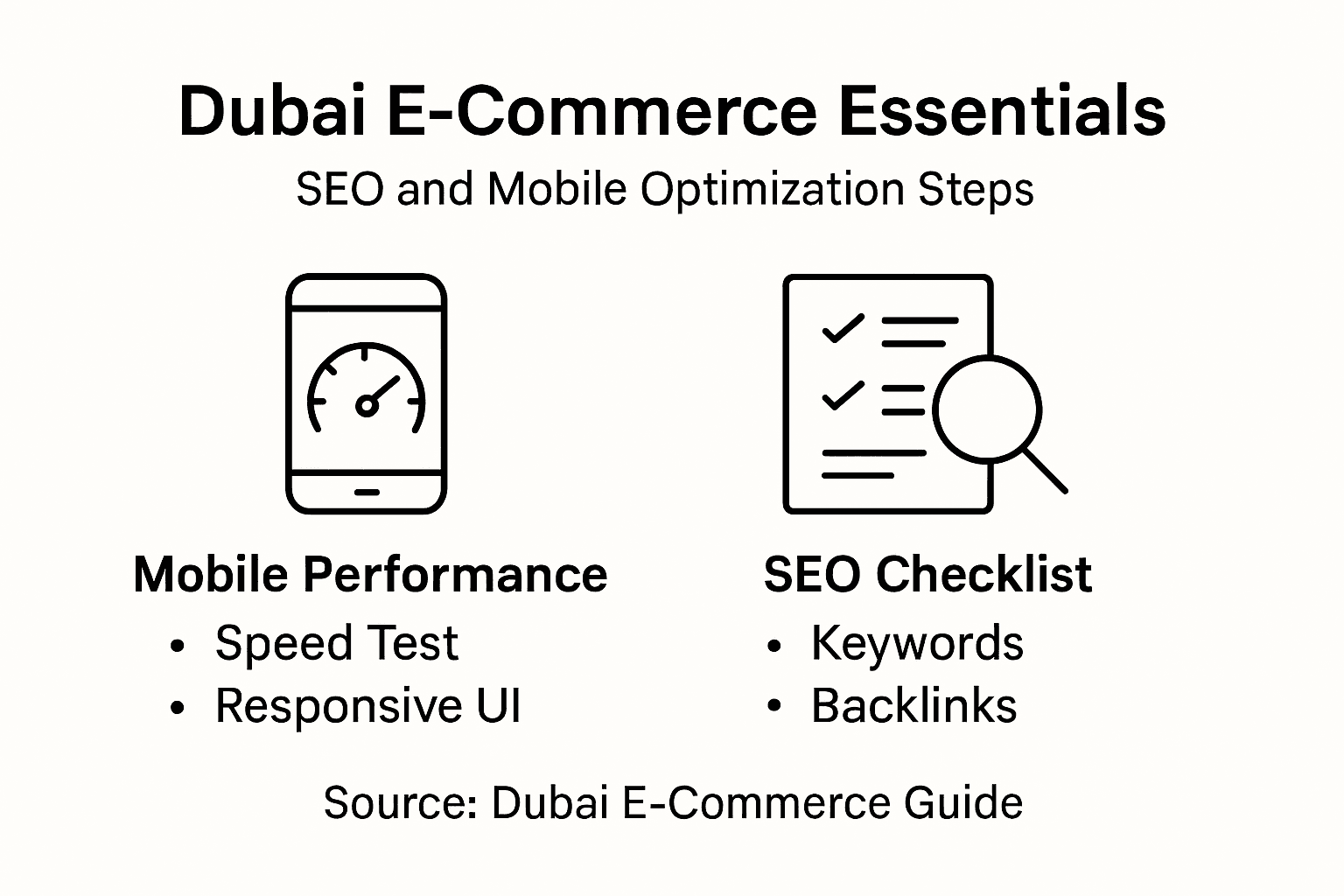
Mobile performance directly affects your search rankings. Google uses mobile-first indexing, meaning it evaluates your site primarily through how it appears on mobile devices. This isn’t a secondary concern—it’s how search engines decide whether to show your site to customers searching on their phones.
Start with technical SEO foundations. Your site needs a clean structure that search engines can easily crawl, fast loading speeds, and secure HTTPS encryption. Mobile optimization significantly impacts your ability to rank well and drive organic traffic to your site.
Focus on these mobile performance essentials:
- Page speed optimization: Compress images, minimize code, leverage caching
- Responsive design: Content must adapt perfectly to all screen sizes
- Touch-friendly elements: Buttons and links should be easily tappable on small screens
- Streamlined checkout: Mobile users abandon carts when checkout feels clunky
- Fast server response times: Target under two seconds for initial page load
Keyword research and optimization matter for visibility. Identify the terms Dubai shoppers use when searching for your products. Incorporate these keywords naturally into product titles, descriptions, meta tags, and headings—not as stuffing, but as genuine content elements.
Build quality backlinks by getting mentioned on relevant Dubai business websites and local directories. Each quality link signals to Google that your site is trustworthy and relevant.
Content marketing drives both SEO and customer engagement. Create helpful guides, product comparisons, or Dubai shopping tips that answer customer questions. This positions you as an authority and attracts organic traffic over time.
Monitor your performance continuously using tools like Google Search Console and Google Analytics. Track which pages rank well, where visitors drop off, and which keywords drive conversions. This data guides your optimization efforts.
A site optimized for mobile and search engines isn’t just better for rankings—it’s genuinely better for customers. Speed and usability matter more than any trick.
Pro tip: Test your site’s mobile performance using Google’s PageSpeed Insights tool and implement the recommended improvements first. This single action typically boosts both your search rankings and conversion rates more than almost anything else you can do.
Step 5: Verify site functionality and launch for Dubai audiences
Before you go live, thorough testing ensures your site works flawlessly for customers. A broken checkout or slow-loading pages on launch day will damage your reputation and cost you sales.
Start with functional testing across all major browsers and devices. Test on Chrome, Firefox, Safari, and Edge. More importantly, test extensively on iPhone and Android devices since most Dubai shoppers use mobile phones. Click every button, add products to carts, complete purchases, and verify everything works smoothly.
Pay special attention to payment processing. Process test transactions using your payment gateway to confirm receipts arrive, refunds work correctly, and currency conversion is accurate. Comprehensive verification processes before launch prevent costly issues after customers start using your site.
Create a detailed testing checklist covering these areas:
- Payment processing: Test all payment methods with real transactions
- Mobile responsiveness: Verify on multiple screen sizes and orientations
- Page speed: Check loading times on slow connections
- Forms and submissions: Test contact forms, account creation, and checkout
- Search functionality: Ensure product search returns accurate results
- Inventory management: Confirm stock levels update correctly after purchases
- Email notifications: Verify order confirmations and shipping alerts send properly
- Legal compliance: Review terms of service, privacy policy, and local UAE requirements
Invite trusted customers or team members to test your site before launch. Real users often catch issues that developers miss. Ask them to navigate naturally and provide honest feedback about their experience.
Plan your launch timing strategically. Avoid launching during major holidays or shopping events until you’re confident your site handles traffic. Start with a soft launch, monitoring performance closely before full promotion.
After launching, monitor your site continuously for bugs and performance issues. Set up analytics tracking to understand customer behavior and identify friction points. Be prepared to make quick fixes if problems emerge.
A perfect launch is less important than a quick response to problems discovered post-launch—launch when ready enough, then optimize based on real customer data.
Pro tip: Create a live monitoring dashboard showing real-time metrics like page speed, error rates, and transaction success. Check it daily for the first month after launch—you’ll catch issues early and gain confidence that your site is performing well for customers.
Build Your Dubai E-Commerce Success with Expert Web Solutions
Launching a high-performing e-commerce site in Dubai means tackling challenges like responsive mobile design, secure payment integration, and compliance with local regulations. If you are striving to meet ambitious revenue goals while delivering seamless user experiences that convert, you need a partner who understands Dubai’s unique market demands and consumer behaviors. Critical elements such as intuitive navigation, fast loading speeds, and trustworthy payment systems require skilled development combined with strategic insights from real Dubai professionals.

DubaiWebCity specializes in creating custom, responsive e-commerce platforms designed specifically for Dubai businesses. With over 20 years of experience, our expert team builds websites that balance impactful design and robust functionality. From secure, PCI-compliant payment integration to mobile-first SEO optimization and ongoing post-launch support, we ensure your digital store not only launches successfully but scales confidently. Start meeting your business goals today by partnering with DubaiWebCity. Visit our site to learn how our solutions align perfectly with the steps in building e-commerce sites in Dubai outlined in this article.
Frequently Asked Questions
What are the first steps to take when building an e-commerce site in Dubai?
Before you start, clearly define your business goals and understand the unique market requirements in Dubai. Outline what success looks like for your business, such as revenue targets or customer acquisition numbers. Aim to establish this foundational understanding within the first few weeks of your planning phase.
How can I choose the right e-commerce platform for my Dubai business?
Evaluate whether to build a custom site or use a pre-built platform based on your budget and specific needs. Consider factors like scalability, flexibility, and how well the platform caters to mobile users, as most Dubai shoppers browse on their phones. Make your choice within the first month to stay on track with your project timeline.
What payment security measures should I implement for my e-commerce site?
Implement robust security measures, including PCI DSS compliance and SSL encryption, to protect customer data and build trust. Ensure you have multi-layered security protocols in place, such as tokenization and fraud detection tools, by the time your site launches to avoid issues after going live.
How can I optimize my site for search engines in Dubai?
Focus on both technical and on-page SEO strategies to improve your search visibility. Conduct keyword research relevant to Dubai consumers and optimize your product pages, metadata, and content accordingly. Achieve noticeable improvements in search rankings within 60 days by regularly monitoring your site’s performance and making data-driven adjustments.
What are the best practices for testing my e-commerce site before launch?
Conduct comprehensive testing across various devices and browsers, ensuring payment processing, mobile responsiveness, and overall functionality work flawlessly. Create a detailed checklist covering key areas like checkout processes and email notifications, and complete this testing phase at least two weeks prior to your official launch to address any issues effectively.
How do I keep track of my site’s performance after launching?
Set up monitoring tools to track real-time metrics like page speed, transaction success rates, and error rates after launch. Check these metrics daily for the first month to promptly identify and resolve any emerging issues, ensuring a smooth experience for your customers.
Recommended
- Ecommerce Website Development Dubai – Web Design Dubai – Website Design Company Dubai | NetSoft
- Big Commerce Development – Web Design Dubai – Website Design Company Dubai | NetSoft
- Magento Ecommerce Development Dubai – Web Design Dubai – Website Design Company Dubai | NetSoft
- Shopify Ecommerce Development – Web Design Dubai – Website Design Company Dubai | NetSoft