TL;DR:
- UX strategy connects business goals with user needs, guiding website decisions for better results.
- Building a UX strategy involves diagnosing issues, setting policies, and prioritizing impactful actions.
- Continuous improvement and focus on solving real problems are essential for effective UX in Dubai SMEs.
Most Dubai SME websites don’t struggle because of bad design. They struggle because there’s no structured plan connecting what users need to what the business wants to achieve. A polished homepage means nothing if visitors can’t find what they’re looking for or don’t trust the brand enough to take action. User experience strategy is the missing layer that turns a website from a digital brochure into a growth engine. This article breaks down what UX strategy actually is, what it’s made of, and how you can build one that delivers measurable results for your Dubai business.
Table of Contents
- What is user experience strategy?
- Core components of a UX strategy
- How UX strategy delivers business value for Dubai SMEs
- Building a practical UX strategy: step-by-step for Dubai SMEs
- The uncomfortable truth about UX strategy for Dubai SMEs
- Next steps: elevate your Dubai SME website
- Frequently asked questions
Key Takeaways
| Point | Details |
|---|---|
| UX strategy defined | A UX strategy is a blueprint for aligning website user needs with business goals to drive measurable results. |
| Core components | Successful UX strategies include vision, goals, metrics, a roadmap, user segments, and prioritization. |
| Business value proof | Dubai SMEs gain higher conversions and user retention by implementing a purposeful UX strategy. |
| Step-by-step framework | Diagnose, set guardrails, and outline actions to create a practical, effective UX strategy. |
| Focus on measurable impact | Tracking KPIs across key user journeys ensures continuous improvement and business growth. |
What is user experience strategy?
Let’s clear up a common misconception first. UX strategy is not the same as UX design. Design is about how things look and feel. Strategy is about why you’re making those decisions and what you want to achieve with them. Many Dubai SME owners invest in a redesign, get a beautiful website, and still see flat conversion numbers. That’s the gap strategy fills.
A UX strategy is a detailed plan aligning brand identity with the desired user experience at every touchpoint. It’s the bridge between your business goals and the actual behavior of your users. Think of it as the blueprint that guides every design, content, and functionality decision on your website.
Here’s where it gets interesting. Strategy and planning are often confused, but they serve different purposes:
- Strategy answers what you want to achieve and why it matters
- Planning answers how you’ll do it and when it happens
- Design is the execution layer that brings both to life
Without strategy, planning becomes guesswork. You might build a beautiful navigation menu without ever asking whether users actually need it, or whether it supports a key conversion path.
“UX strategy is a detailed plan aligning brand identity with desired user experience at every touchpoint.” — Coursera
For Dubai SMEs, this distinction is especially important. Your website serves a diverse, multilingual audience with high expectations for speed, clarity, and trust signals. A strategy forces you to ask the right questions before spending a dirham on development.
When you work on improving website UI and UX, you’re already operating at the design and planning level. But layering a proper UX strategy on top of that work is what separates websites that look good from websites that actually perform. It also connects directly to boosting Dubai SMB online success by making sure every design choice serves a business purpose.
In short, UX strategy is the guiding blueprint that keeps your website decisions intentional, consistent, and aligned with what your customers actually want.
Core components of a UX strategy
Knowing what UX strategy is doesn’t automatically tell you what goes inside one. Let’s break it down into the building blocks that every effective strategy must include.

A practical UX strategy includes six components: risks, feasibility, high-value actions, priorities, user segments, and a target goal. Each one plays a specific role in keeping your strategy grounded and actionable.
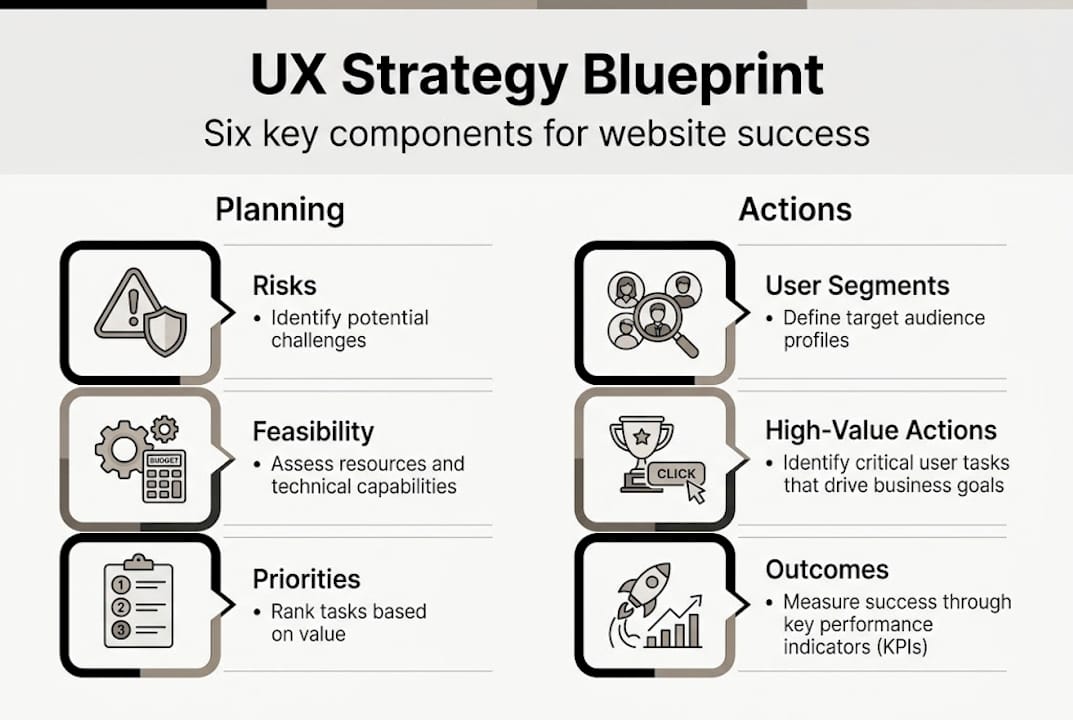
Here’s how those components map to real decisions:
| Component | What it means | Why it matters |
|---|---|---|
| Target goal | The business outcome you want | Keeps every decision anchored |
| User segments | Who your users actually are | Prevents generic, ineffective design |
| High-value actions | What users must do to convert | Focuses effort where it counts |
| Priorities | What gets done first | Avoids spreading resources thin |
| Feasibility | What’s realistic given your constraints | Keeps the strategy executable |
| Risks | What could go wrong | Helps you plan for failure early |
Building a UX strategy means working through each of these in sequence:
- Define your target goal. What does success look like? More inquiries, longer sessions, higher checkout rates?
- Identify your user segments. Who visits your website and what do they need? A Dubai-based B2B buyer behaves very differently from a retail consumer.
- Map high-value actions. What specific actions lead users toward your goal? These become your design priorities.
- Assess feasibility and risks. What’s technically possible with your current platform? What could derail the strategy?
- Set priorities. You can’t fix everything at once. Rank improvements by impact and effort.
Understanding the UI and UX roles involved in executing this strategy helps you assign the right tasks to the right people. And following UI UX best practices ensures that your strategy translates into design decisions that actually work for your audience.
The key insight here is that a UX strategy without all six components is incomplete. Miss user segments and you’ll design for the wrong people. Skip risks and you’ll be surprised when things break down.
How UX strategy delivers business value for Dubai SMEs
Strategy sounds theoretical until you see what it does to real numbers. For Dubai SMEs, a well-executed UX strategy has a direct line to revenue, retention, and reputation.
UX design that meets user needs in a way that makes commercial sense is the core promise of UX strategy. That means your website isn’t just user-friendly. It’s user-friendly in ways that serve your business.
Here’s what that looks like in practice:
- Higher conversions: When users can find what they need quickly and trust your brand, they take action. A strategy that maps user journeys to conversion points removes friction at every step.
- Better retention: Users who have a consistent, positive experience come back. Repeat visitors are significantly cheaper to convert than new ones.
- Stronger word-of-mouth: In Dubai’s business community, referrals matter. A website that impresses users becomes a talking point.
The difference between websites with and without a UX strategy is stark:
| Factor | With UX strategy | Without UX strategy |
|---|---|---|
| User journey | Intentional, mapped to goals | Accidental, based on design trends |
| Conversion rate | Optimized through testing | Unknown or stagnant |
| Design decisions | Evidence-based | Preference-based |
| Business alignment | Clear at every touchpoint | Inconsistent or absent |
Pro Tip: Set KPIs tied to specific user journeys, not just overall traffic. Track metrics like task completion rate, drop-off points in your checkout or inquiry flow, and time-on-page for key landing sections. These tell you far more than pageviews alone.
For practical guidance on building this kind of impact, the practical UX strategy framework from Smashing Magazine is a solid starting point. It connects directly to what drives effective web design for SMB growth in competitive markets like Dubai. You’ll also find that applying UI/UX tips for engagement becomes far more effective when those tips are guided by a clear strategy rather than applied in isolation.
Building a practical UX strategy: step-by-step for Dubai SMEs
Now let’s get specific. Here’s a proven framework you can start applying to your website today.
The core UX strategy framework follows three stages: diagnose, set guiding policies, and outline actions. It’s simple enough to implement without a large team, and structured enough to produce real results.
-
Diagnose your current website UX. Before you fix anything, understand what’s broken. Use heatmaps, session recordings, and user feedback to identify where visitors drop off, get confused, or abandon their journey. Look at your analytics for high-exit pages and low-conversion flows. This is your baseline.
-
Set guiding policies and guardrails. This is the step most SMEs skip, and it’s the most important one. Guiding policies define what you will not do. For example: “We will not add features that slow page load below 3 seconds” or “We will not prioritize aesthetics over clarity in navigation.” These guardrails prevent scope creep and keep your team aligned.
-
Outline key actions and priorities. Based on your diagnosis and guardrails, list the specific improvements that will move the needle. Rank them by impact on your target goal and feasibility given your resources.
Pro Tip: Focus your first round of improvements on your highest-value user journey, which is the path a user takes from landing on your site to completing your most important conversion action. Fix that journey completely before moving to secondary flows.
Avoid confusing strategy with tactical planning. Deciding to “redesign the contact page” is a tactic. Deciding that “users must be able to reach a human within two clicks from any page” is a strategic policy. The tactic serves the strategy, not the other way around.
Applying design thinking in web design supports this process by keeping user empathy at the center of every decision. If you need professional support, working with a UI UX agency in Dubai can accelerate results significantly. And if your current website needs a full overhaul, a structured website redesign strategy ensures the rebuild is guided by strategy rather than aesthetics alone.
The uncomfortable truth about UX strategy for Dubai SMEs
Here’s what most guides won’t tell you. The biggest threat to your UX strategy isn’t a bad design or a slow website. It’s the temptation to chase trends instead of solving real problems.
We’ve seen Dubai SMEs invest heavily in the latest design styles, animated hero sections, chatbot integrations, and parallax scrolling, without ever diagnosing why their current website isn’t converting. The result is a more expensive version of the same problem.
Real UX strategy is about focus. It means choosing to ignore certain improvements so you can do the important ones well. That requires honest measurement, which most businesses avoid because the numbers can be uncomfortable.
The other thing experts rarely say out loud: a UX strategy is never finished. It’s a continuous cycle of diagnosing, adjusting, and improving. The businesses that win online in Dubai aren’t the ones who launched the best website. They’re the ones consistently committed to boosting user experience for SMBs through small, measurable improvements over time. One good strategy cycle beats ten scattered redesigns.
Next steps: elevate your Dubai SME website
Having explored the critical insights and the candid truths about UX strategy, let’s look at how DubaiWebCity can help turn knowledge into measurable website results.
At DubaiWebCity, we’ve spent over 20 years helping Dubai businesses build websites that do more than look good. We build websites that work, guided by clear UX strategy, user research, and business alignment. Whether you need creative web design ideas to refresh your brand, a fully responsive website design that performs across devices, or end-to-end support from our UI UX agency in Dubai, we’re ready to help you build a strategy that delivers real growth. Let’s turn your website into your strongest sales asset.
Frequently asked questions
What is a user experience strategy in website design?
User experience strategy is a blueprint that aligns user needs with business goals, guiding decisions across every website touchpoint. A UX strategy aligns brand identity with the desired experience at each stage of the user journey.
How does UX strategy differ from UX design?
UX strategy defines what and why to do for user experience, while UX design is how and when those plans are executed. Strategy answers what and why, while planning and design answer how and when.
What are the main steps to building a UX strategy for a Dubai SME?
Start by diagnosing your website’s current state, set guiding policies, and outline key actions toward your business goals. The diagnose, guardrails, actions cycle gives you a repeatable process for continuous improvement.
How do Dubai SMEs measure the impact of a UX strategy?
Measure using relevant KPIs such as conversion rates, user retention, and engagement across high-value user journeys. Goals and metrics are a core component of any effective UX strategy.
Can I implement UX strategy without hiring experts?
Yes, SMEs can use practical frameworks and start small, but expert guidance often accelerates results and helps avoid common mistakes. The diagnose to actions methodology is designed to be accessible even for teams without dedicated UX staff.