
Running a retail store or healthcare clinic in Dubai means always searching for smarter ways to serve customers and work efficiently. When daily tasks start to pile up and engagement feels flat, custom mobile apps offer a direct path to improvement. This guide breaks down the structured mobile app development process, highlights the options you can choose, and explains real benefits for your business so you can find solutions that fit your needs and budget.
Table of Contents
- What Mobile App Development Involves
- Types of Mobile Apps for Dubai Businesses
- Key Benefits for Retail and Healthcare
- Cost, Process, and Development Trends
- Data Security, Maintenance, and Support
Key Takeaways
| Point | Details |
|---|---|
| App Development Phases | The mobile app development process involves ideation, design, coding, testing, and ongoing maintenance, each crucial for success. |
| Choosing App Type | Businesses must evaluate native, hybrid, or web apps based on their specific needs, budget, and desired user experience. |
| Importance of Security | Data security is essential as breaches can damage trust and lead to significant legal repercussions, particularly in retail and healthcare. |
| Budgeting and Costs | Accurate budgeting for app development is vital, as costs vary widely depending on complexity, features, and maintenance needs. |
What Mobile App Development Involves
Mobile app development is the process of creating software for smartphones and tablets. For retail and healthcare businesses in Dubai, it means building applications that customers or patients interact with directly on their phones.
The process flows through distinct phases, each critical to the final product.
The Core Phases
Development starts with ideation and research. You define what your app does, who uses it, and what problems it solves. A retail store might need an app for loyalty programs; a clinic might need appointment scheduling and patient records.
Design comes next. This shapes how users navigate your app and experience your brand. Poor design frustrates users and kills adoption quickly.
Mobile application development involves multiple critical stages:
- Ideation and business requirement gathering
- Research into user needs and competitor apps
- Wireframing and prototyping the user interface
- Visual design and brand integration
- Coding and feature development
- Quality assurance and bug testing
- Deployment to app stores
- Post-launch maintenance and updates
Development is where developers write the actual code. This stage typically takes the longest and determines whether your app performs smoothly or crashes under load.
Testing catches bugs before customers encounter them. Your app gets tested across different devices, screen sizes, and Android or iOS versions. This phase is non-negotiable in healthcare or retail, where failures damage trust.
Choosing Your Development Approach
You’ll face three main paths when building with a partner like NetSoft:
- Native apps: Built separately for Android and iOS using platform-specific languages. Faster performance, better access to device features. Higher cost because you’re essentially building twice.
- Hybrid apps: Single codebase runs on multiple platforms. Faster to develop, lower cost. Slightly slower performance than native.
- Web apps: Run in browsers rather than app stores. Easiest to build, lowest cost. Limited access to phone features like cameras or location services.
Your app’s success depends on matching the right approach to your business goals and budget, not on choosing the trendiest option.
Post-Launch Reality
Deployment isn’t the finish line. Your app requires ongoing maintenance. Operating systems update, security vulnerabilities emerge, user feedback reveals missing features. Retail apps need inventory updates; healthcare apps need compliance adjustments.
You’ll work with your development team on continuous improvements based on user behavior and market feedback.
What This Means for Your Business
Understanding these phases helps you budget realistically. Simple apps (single function, basic design) take 2-4 months. Complex healthcare or retail apps with payment integration, real-time data, and extensive testing take 6-12 months. Costs range from AED 50,000 for basic solutions to AED 500,000 for sophisticated applications.
Pro tip: Start with a clear list of must-have features versus nice-to-have features before discussing development timelines with your provider. This prevents scope creep that delays launch and inflates costs.
Types of Mobile Apps for Dubai Businesses
Dubai businesses don’t operate with a one-size-fits-all approach to mobile apps. Your retail store, healthcare clinic, or service business has unique requirements that determine which type of app makes sense for you.
Choosing the right app type affects speed to market, cost, performance, and long-term maintenance. The wrong choice wastes money and frustrates both you and your users.
Native Apps: Maximum Power
Native apps are built specifically for one platform. Android app development creates apps exclusively for Android devices, while iOS apps run only on iPhones and iPads.
Native apps deliver the fastest performance and deepest access to phone features. A healthcare app tracking real-time patient vitals or a retail app processing secure payments benefits from this raw power.

The tradeoff is cost and timeline. Building separate Android and iOS versions means paying twice for development. A clinic needing appointment reminders and prescription management might spend AED 150,000 or more to launch on both platforms.
Native apps work best when:
- Your business demands absolute performance speed
- You need advanced camera, GPS, or sensor access
- Your budget supports building two separate applications
- You’re targeting either Android or iOS users exclusively
Hybrid Apps: Smart Balance
Hybrid apps use a single codebase that runs on multiple platforms. Think of it as building once, deploying everywhere.
Development is faster and cheaper than native apps. Many Dubai retailers use hybrid solutions for loyalty programs and inventory management because they reach both Android and iOS users without doubled expenses.
Performance is slightly slower than native apps, but most customer-facing business functions won’t notice the difference. A retail POS app or healthcare scheduling system functions perfectly well in hybrid format.
Hybrid apps suit you if:
- You need to support both Android and iOS simultaneously
- Your timeline is tight (4-6 months versus 6-12 months for dual native)
- Your budget is moderate (AED 80,000 to AED 200,000)
- Your app doesn’t require intensive gaming or real-time data processing
The hybrid approach dominates Dubai’s mobile app landscape because it balances cost, speed, and functionality for typical business needs.
Web Apps: Lightweight and Fast
Web apps run in a browser rather than requiring installation from an app store. Users access your app through a web link on their phone.
They’re the quickest and cheapest option. A healthcare clinic could launch a telemedicine appointment portal or a retail store could offer a simple product catalog in 1-2 months for AED 30,000 to AED 70,000.
The limitation is phone feature access. Web apps can’t reliably access cameras, offline storage, or location services. You’re also dependent on internet connectivity.
Web apps work well for:
- Quick launches and MVP testing
- Information-based services (menus, schedules, catalogs)
- Limited budgets
- Businesses wanting fast time-to-market
Which Type Fits Your Business
Retail stores in Dubai typically use hybrid apps for loyalty programs and product browsing. Healthcare providers lean toward native apps when handling sensitive patient data or telemedicine features, or hybrid when building patient scheduling systems.
Your choice depends on budget, timeline, feature complexity, and user volume. A small healthcare clinic starting with appointment scheduling might choose hybrid. A large retail chain processing thousands of daily transactions might invest in native for superior performance.
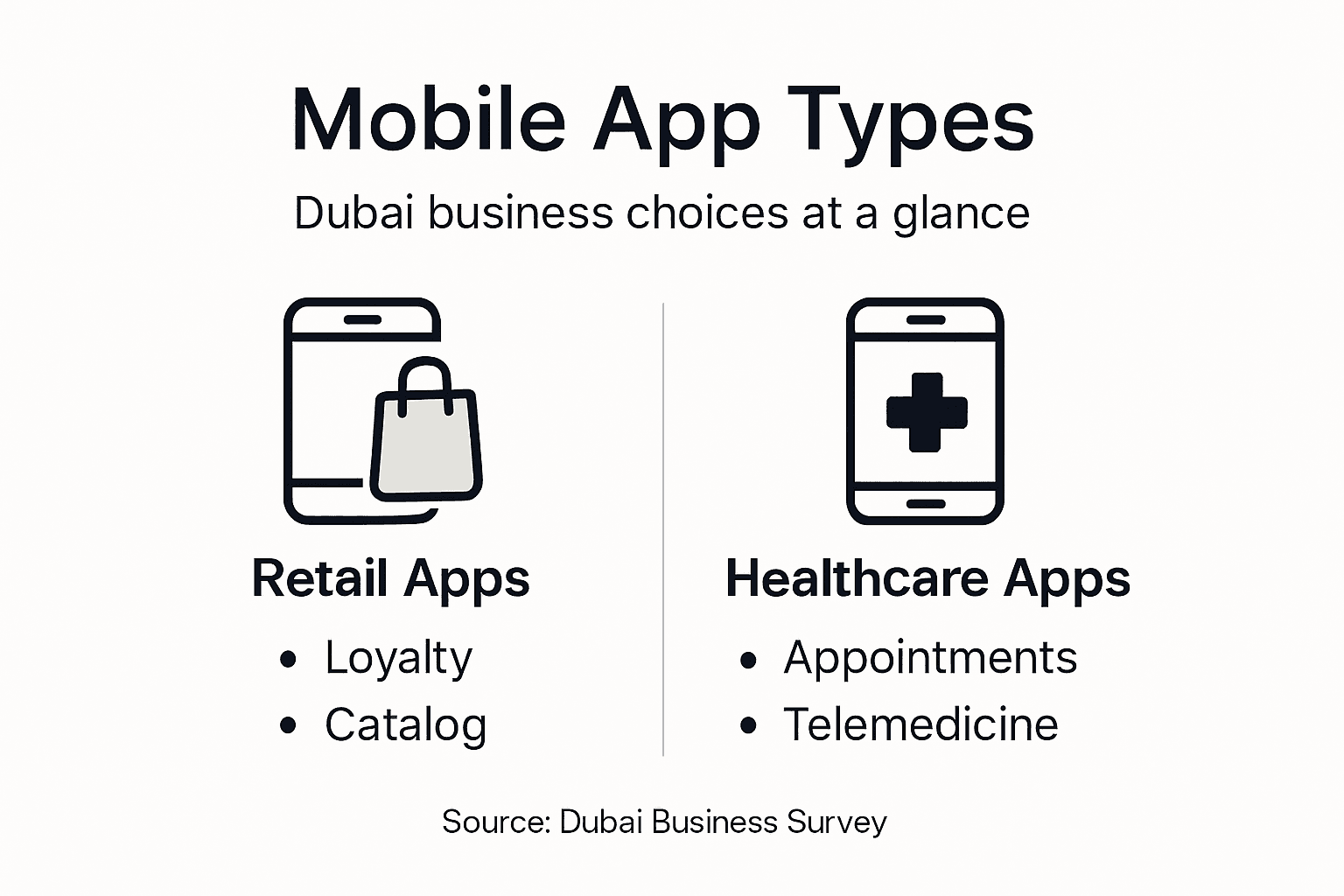
To help you decide which development approach suits your business needs, here’s a quick comparison:
| Type of App | Development Cost | Feature Access | Best For |
|---|---|---|---|
| Native | Highest (twice for both platforms) | Full device integration | Performance-critical, complex apps |
| Hybrid | Moderate (single codebase) | Most device features | Retail loyalty, scheduling |
| Web | Lowest (fastest to launch) | Limited device access | Content catalogs, telemedicine portals |
Pro tip: Start by listing your critical features and non-negotiables, then discuss which app type matches those requirements with your development partner—this prevents expensive pivots after development starts.
Key Benefits for Retail and Healthcare
Mobile apps aren’t just nice-to-have anymore. For retail stores and healthcare clinics in Dubai, they’re direct paths to revenue growth and operational efficiency.
Your competitors are already using apps to capture customers and streamline operations. Standing still means falling behind.
Retail Benefits: Driving Sales and Loyalty
Retail apps transform how customers shop and how you understand their behavior. Mobile apps in retail provide real-time sales insights, allowing you to see which products move fastest, which promotions convert, and what customers actually want.
A loyalty program built into your app changes customer behavior. Instead of one-time buyers, you create repeat customers who earn points, receive personalized offers, and feel valued.
Mobile payment integration makes checkout frictionless. Customers spend less time in line and more time buying. Payment failures drop significantly when apps handle transactions securely.
Retail apps deliver:
- Real-time inventory visibility across all locations
- Personalized product recommendations based on purchase history
- Push notifications for flash sales and new arrivals
- One-tap loyalty program enrollment and redemption
- Virtual try-on features for apparel and accessories
- Seamless integration with your physical store experience
Apps convert casual browsers into loyal customers by making shopping convenient and rewarding.
Healthcare Benefits: Improving Patient Care and Operations
Healthcare apps solve a fundamental problem: patients struggle to access information and schedule appointments, while clinics waste time on administrative work.
Mobile health applications enable remote consultations, real-time health monitoring, and streamlined appointment scheduling. A patient manages their diabetes management app at home instead of calling your clinic repeatedly.
Telemedicine features expand your reach. Patients outside Dubai can consult specialists at your clinic without traveling. You generate revenue from appointments that previously required physical presence.
Electronic health records accessible through your app reduce paperwork and prescription errors. Patients refill medications with two taps instead of calling and waiting.
Healthcare apps offer:
- Appointment scheduling with automated reminders
- Real-time health monitoring and patient alerts
- Secure messaging between patients and providers
- Electronic prescription management
- Medical record access for patient empowerment
- Telehealth consultations for remote patients
- Reduced no-show rates through appointment reminders
The Business Impact Both Sectors Share
Both retail and healthcare see operational costs drop when apps handle routine tasks. Fewer phone calls means fewer staff needed for scheduling and inquiries. Automation reduces human error.
Customer satisfaction increases visibly. Patients and shoppers appreciate convenient access, personalized experiences, and reduced wait times.
Data collection through apps reveals what actually matters to your customers, not what you assume matters. This insight drives smarter decisions about inventory, staffing, and services.
Here’s a summary of how retail and healthcare apps create measurable business value:
| Sector | Customer Value | Operational Impact | Typical Feature |
|---|---|---|---|
| Retail | Faster checkout, loyalty rewards | Inventory management, real-time analytics | Virtual try-on |
| Healthcare | Easier appointments, telehealth | Reduced paperwork, fewer errors | Health monitoring |
| Both | Personalized user experience | Lower costs, improved satisfaction | Secure messaging |
Pro tip: Interview 10-15 of your best customers before building your app to understand their pain points, then prioritize features that solve those specific problems rather than copying competitor apps.
Cost, Process, and Development Trends
Budgeting for a mobile app requires understanding what you’re actually paying for. Many Dubai business owners underestimate costs or overestimate timelines, then get frustrated when reality doesn’t match expectations.
Knowing the pricing landscape helps you make informed decisions and avoid wasting money on the wrong approach.
What Your App Actually Costs
App development pricing depends on complexity, platform choice, and features you need. Mobile app development costs vary dramatically based on these factors.
Simple apps with basic features cost AED 20,000 to AED 180,000. Think loyalty program, basic scheduling, or simple product catalog. These launch in 2-4 months.
Mid-range apps with more sophisticated features cost AED 150,000 to AED 400,000. A healthcare clinic app with appointment scheduling, patient records, and messaging falls here. Timeline stretches to 4-6 months.
Complex apps with payment processing, real-time data, and advanced integrations exceed AED 400,000. Timeline extends to 6-12 months or longer.
Cost drivers include:
- Design complexity and user experience refinement
- Backend infrastructure and database requirements
- Third-party integrations (payment systems, maps, analytics)
- Security and compliance features
- Testing across multiple devices and platforms
- Ongoing maintenance and updates
The Development Process
Understanding the workflow prevents surprises. Your app goes through defined phases, each requiring time and investment.
Discovery and planning happens first. You define requirements, scope features, and identify technical challenges. This clarity prevents costly changes later.
Design follows. Your app’s interface is prototyped and refined based on user feedback. Design quality directly impacts user adoption rates.
Development is where code gets written. Modern teams use agile methodologies, delivering working features incrementally rather than waiting for a massive release.
Testing happens continuously, not just at the end. Bugs get caught early, reducing expensive fixes after launch.
Deployment to app stores requires compliance with Apple and Google guidelines. This takes 1-2 weeks typically.
Emerging Trends Shaping Development Today
Current app development trends emphasize AI integration, cross-platform frameworks, and progressive web apps. These aren’t just buzzwords—they reduce costs and speed up delivery.
AI-powered features like chatbots handle customer inquiries automatically. A retail app recommending products based on browsing history increases sales. A healthcare app detecting health trends alerts patients proactively.
Cross-platform frameworks like Flutter and React Native let developers write code once, deploy everywhere. This cuts development time by 30-40% compared to building separate native apps.
Progressive web apps bridge web and mobile app experiences, offering another cost-effective option for information-based services.
Emerging technologies worth considering:
- AI chatbots for customer service automation
- Augmented reality for virtual try-ons in retail
- Real-time health monitoring integrations
- Blockchain for secure healthcare records
- 5G optimization for faster data transfer
Maintenance costs run 15-20% of initial development annually. Budget this now or face surprise expenses later.
Timeline Expectations
Simple apps launch in 2-4 months. Mid-range apps require 4-6 months. Complex apps need 6-12 months. These timelines assume clear requirements and minimal scope changes.
Delay factors include unclear requirements, late feedback, design revisions, and integration challenges. Communicating clearly with your development partner prevents most delays.
Pro tip: Request a fixed-price quote with clearly defined features and deliverables, then establish a change management process that requires approval before scope additions—this prevents runaway timelines and costs.
Data Security, Maintenance, and Support
Your app launching is just the beginning. What happens after deployment determines whether your investment pays off or becomes a liability.
Security breaches, performance crashes, and abandoned apps damage reputation faster than they’re built. Retail stores lose customers. Healthcare clinics face legal consequences. Both sectors suffer revenue loss.
Why Security Matters More Than You Think
Retail and healthcare apps handle sensitive data. Customer payment information, personal health records, loyalty program data—breaches expose your business to lawsuits, fines, and destroyed customer trust.
Dubai’s data protection laws require secure handling of customer information. Non-compliance means penalties and operational shutdown risk.
Data security requires constant vigilance. Security threats evolve daily. Hackers find new vulnerabilities. Outdated apps become targets.
Essential security measures include:
- Encryption of data in transit and at rest
- Regular security audits and penetration testing
- Secure user authentication and password protocols
- Compliance with Dubai and UAE data protection regulations
- Regular security patches and updates
- Access controls limiting employee data visibility
- Secure API integrations with third-party services
A single breach costs more than years of maintenance. Security isn’t optional—it’s mandatory.
Ongoing Maintenance Prevents Catastrophe
Effective app maintenance and support includes regular updates, performance monitoring, and user feedback incorporation. These practices reduce downtime, prevent security breaches, and enhance user satisfaction.
Operating systems update constantly. Apple releases iOS updates. Google releases Android updates. Your app must adapt or it crashes on new devices.
Performance degrades over time. User bases grow. Data accumulates. Without optimization, your app slows down, users abandon it, and revenue stops flowing.
A structured maintenance schedule covers:
- Monthly performance reviews and monitoring
- Quarterly software updates and feature improvements
- Security patches released immediately when vulnerabilities emerge
- Biannual user training and documentation updates
- Annual comprehensive security audits
- Bug fixes based on user reports
Neglecting maintenance costs more than investing in it. A crashed app during peak sales season costs thousands in lost revenue.
Post-Launch Support: Your Safety Net
Problems emerge after launch despite thorough testing. A user reports a bug. A feature doesn’t work as expected. An integration fails. You need responsive support.
Your development partner should provide post-launch support for at least 6 months. This includes bug fixes, performance optimization, and minor feature adjustments based on real-world usage.
Support should be accessible when issues occur, not days later. Response time matters when your app is down.
Maintenance Costs Are Investments, Not Expenses
Maintenance typically costs 15-20% of initial development annually. A AED 200,000 app requires AED 30,000 to AED 40,000 yearly in maintenance.
This isn’t money wasted. It’s insurance against downtime, security breaches, and user frustration. The alternative—no maintenance—leads to app failure within 12-18 months.
Pro tip: Negotiate post-launch support into your development agreement before work starts, specifying response times, included services, and maintenance scope—this prevents confusion and ensures your app stays healthy after launch.
Unlock Dubai Business Growth with Expert Mobile App Development
The article highlights the challenges Dubai businesses face in choosing the right mobile app development approach, managing complex feature requirements, and ensuring ongoing security and maintenance. These pain points can stall your growth and frustrate your customers. At DubaiWebCity, we understand the crucial importance of matching your business goals with the best development strategy—whether a native, hybrid, or web app—to perfectly balance cost, performance, and timeline.
Avoid costly delays and ensure your app delivers exceptional user experiences with our tailored solutions. We specialize in crafting custom mobile apps and digital services that empower retail and healthcare businesses across Dubai to drive sales, increase customer loyalty, and streamline operations. From initial ideation and UI/UX design to rigorous testing and post-launch support, DubaiWebCity’s experienced team is your trusted partner in turning your mobile app vision into reality.
Ready to transform your digital presence and secure your competitive edge in Dubai’s fast-moving market? Discover how DubaiWebCity can help you achieve reliable, secure, and high-performing mobile apps designed for your specific industry needs. Start your journey today by visiting DubaiWebCity or explore our mobile app development services for an expert consultation. Don’t wait—empower your business growth with a trusted digital partner now.
Frequently Asked Questions
How does mobile app development benefit businesses in Dubai?
Mobile app development enhances customer engagement, streamlines operations, and provides valuable data insights, driving business growth in both retail and healthcare sectors.
What are the different types of mobile apps available for businesses?
Businesses can choose from native apps for optimal performance, hybrid apps for cost-effective solutions, and web apps for quick launches, each with unique advantages tailored to specific needs.
What factors should businesses consider when choosing a mobile app development approach?
Key factors include budget, desired features, timeline, target user base, and the level of device integration required; understanding these will help match the right approach to business goals.
Why is ongoing maintenance important for mobile apps?
Ongoing maintenance prevents security breaches, ensures compatibility with system updates, and enhances app performance, ultimately sustaining user satisfaction and retention over time.
Recommended
- Mobile Application Development in Dubai – Web Design Dubai – Website Design Company Dubai | NetSoft
- Android App Development in Dubai – Web Design Dubai – Website Design Company Dubai | NetSoft
- Flutter Apps in Dubai – Web Design Dubai – Website Design Company Dubai | NetSoft
- IOS App Development in Dubai – Web Design Dubai – Website Design Company Dubai |