Dubai’s business landscape demands mobile apps that convert visitors into loyal customers. Yet many SME owners struggle with unclear development processes, ballooning costs, and apps that fail to engage users. This comprehensive guide walks you through proven strategies for building mobile apps that drive real business results. You’ll discover how to choose the right development approach, design for Dubai’s unique market requirements, and maintain your app for maximum ROI. Whether you’re launching your first app or improving an existing one, these actionable insights will help you navigate the development journey with confidence and clarity.
Table of Contents
- Understanding Mobile App Development Basics For Dubai SMEs
- Choosing The Right Development Approach: Native Vs Cross-Platform
- Designing For Dubai’s Market: UX, Language, And Compliance
- Launching And Maintaining Your Mobile App For Maximum ROI
- Enhance Your Digital Presence With Expert App Development
- Frequently Asked Questions
Key takeaways
| Point | Details |
|---|---|
| Agile methodology | Mobile app development follows sprint-based phases from discovery through maintenance for controlled delivery. |
| Cross-platform advantage | Flutter and React Native reduce costs by 40-50% while accelerating time to market compared to native builds. |
| Local compliance matters | UAE regulations and Arabic support must be integrated from day one to avoid expensive rework. |
| Strong ROI potential | SMEs typically see 150-400% returns within 12-24 months through enhanced customer engagement. |
| UX drives success | User experience design and ongoing optimization determine whether your app achieves business goals. |
Understanding mobile app development basics for Dubai SMEs
Mobile app development transforms your business idea into a functional application that customers can download and use on their smartphones. For Dubai SMEs, this process offers powerful advantages: direct customer communication, personalized experiences, and revenue streams that traditional websites can’t match. Apps keep your brand visible on customer devices, sending timely notifications and creating habitual engagement patterns that boost retention rates.
The benefits extend beyond simple visibility. Mobile apps enable offline functionality, faster performance, and seamless integration with device features like cameras and GPS. You can track user behavior with precision, optimize conversion funnels in real time, and build loyalty programs that encourage repeat purchases. These capabilities translate directly into competitive advantages in Dubai’s crowded marketplace.
Mobile app development for SMEs in Dubai typically follows an Agile sprint-based methodology with phases: Discovery/Strategy, Planning/Wireframing, Design (UI/UX), Development, QA/Testing, Deployment/Launch, Marketing, and Maintenance. This iterative approach allows you to validate assumptions, incorporate feedback, and adjust priorities without derailing your entire project. Each sprint delivers tangible progress, keeping stakeholders aligned and budgets under control.
Here’s how business priorities map to each development phase:
- Discovery/Strategy: Define target users, core features, and success metrics
- Planning/Wireframing: Map user journeys and establish technical architecture
- Design: Create visual identity and interaction patterns that reflect your brand
- Development: Build features in priority order with regular testing cycles
- QA/Testing: Validate functionality across devices and user scenarios
- Deployment/Launch: Submit to app stores and coordinate marketing campaigns
- Marketing: Drive downloads through ASO, ads, and customer outreach
- Maintenance: Monitor performance, fix issues, and release feature updates
Pro Tip: Involve key stakeholders in discovery workshops before writing a single line of code. This upfront investment prevents costly misalignments and ensures your app solves real business problems rather than imagined ones.
The mobile application development process demands careful planning, but the payoff justifies the effort. Apps that launch without clear strategy often fail within months, wasting budgets on features nobody uses. By following a structured methodology, you build applications that users actually want and businesses can sustain long term.
Choosing the right development approach: native vs cross-platform
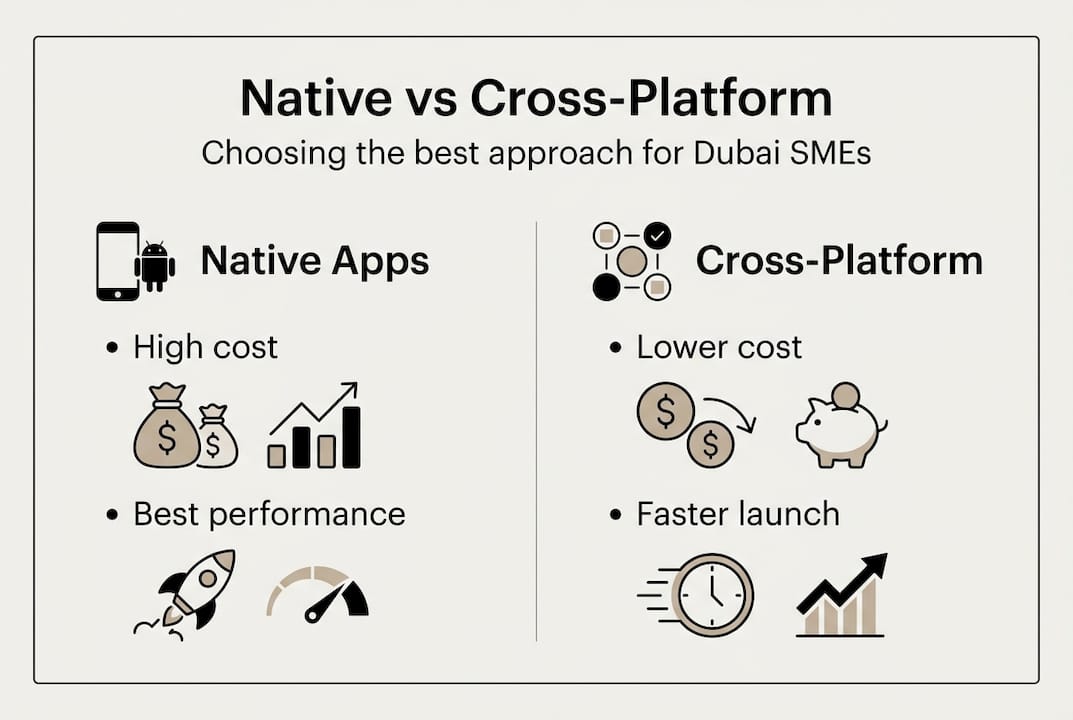
Your development approach determines project costs, launch timelines, and ongoing maintenance requirements. Native apps are built separately for iOS and Android using platform-specific languages like Swift and Kotlin. Cross-platform apps use frameworks like Flutter or React Native to create a single codebase that runs on both operating systems. Each approach offers distinct tradeoffs that directly impact your business outcomes.
| Factor | Native Development | Cross-Platform Development |
|---|---|---|
| Development Cost | Higher (separate iOS and Android teams) | Lower (single codebase serves both platforms) |
| Time to Market | Slower (duplicate work for each platform) | Faster (build once, deploy everywhere) |
| Performance | Excellent (optimized for each platform) | Very good (near-native with modern frameworks) |
| Maintenance | More expensive (update two codebases) | Efficient (one codebase to maintain) |
| Hardware Access | Full access to all device features | Good access (covers 95% of common features) |
Cross-platform frameworks reduce costs by 40-50% and speed time to market versus native development, making them ideal for Dubai SMEs with limited budgets. You can launch your minimum viable product faster, gather user feedback, and iterate without maintaining separate codebases. This approach works brilliantly for business apps, e-commerce platforms, booking systems, and customer portals.
Native development makes sense in specific scenarios:
- Apps requiring cutting-edge AR/VR capabilities
- Games with intensive graphics and real-time processing
- Applications needing deep integration with platform-specific features
- Projects where performance differences create competitive advantages
For most Dubai SMEs, cross-platform delivers the best value proposition. iOS app development in Dubai and Android app development in Dubai both serve important market segments, but splitting your budget between them delays launch and increases risk. Flutter apps in Dubai offer an elegant solution that satisfies both platforms without compromise.
Pro Tip: Validate your app’s complexity and future update requirements before committing to a development approach. If you anticipate frequent feature additions, cross-platform maintenance savings compound dramatically over time.
The technology landscape evolves rapidly, but your choice should prioritize business outcomes over technical preferences. Ask yourself: will native development’s marginal performance gains justify doubled costs and slower iteration cycles? For most SME use cases, the answer is no. Cross-platform frameworks have matured to the point where users can’t distinguish them from native apps in everyday use.
Designing for Dubai’s market: UX, language, and compliance
User experience design determines whether customers embrace your app or delete it after one frustrating session. In Dubai’s multicultural market, effective UX must accommodate diverse user expectations while maintaining intuitive navigation and visual appeal. Your design decisions directly impact engagement metrics, conversion rates, and customer lifetime value.

Dubai’s market demands bilingual support as a baseline requirement. Arabic and English interfaces aren’t optional extras but essential features that expand your addressable market. Right-to-left (RTL) layout support for Arabic requires careful planning during wireframing, not as an afterthought during development. Text expansion, date formats, and cultural preferences all need consideration to create experiences that feel native to Arabic speakers.
Android’s device fragmentation presents unique challenges in emerging markets. Your app must perform smoothly on budget smartphones with limited memory and processing power, not just flagship devices. Testing across diverse hardware configurations prevents poor reviews from users who experience crashes or sluggish performance.
Privacy-by-design, multi-language support, and local UAE compliance must be integrated from the discovery phase to avoid costly rework. The UAE’s Personal Data Protection Law (PDPL) establishes strict requirements for collecting, storing, and processing user information. Financial services, healthcare, and e-commerce apps face additional sector-specific regulations that demand expert guidance.
Key UX design practices for Dubai SMEs include:
- Simplify onboarding to three screens or fewer
- Use familiar navigation patterns that match platform conventions
- Design for thumb-friendly interactions on large screen devices
- Optimize load times to under two seconds for core features
- Implement clear error messages that guide users toward solutions
- Test with real users from your target demographic before launch
Pro Tip: Integrate UAE Pass for secure identity management and streamlined authentication. This government-backed digital identity solution builds user trust while simplifying compliance with verification requirements.
Working with a UI UX design agency in Dubai ensures your app meets local expectations while following international best practices. Design isn’t just about aesthetics; it’s the invisible architecture that guides users toward desired actions. Every button placement, color choice, and animation serves strategic purposes that either support or undermine your business goals.
Understanding mobile app UX guide Dubai SMEs principles helps you evaluate design proposals and make informed decisions throughout development. You don’t need to become a designer yourself, but recognizing good UX when you see it protects your investment and ensures your app delivers the experiences customers expect.
Launching and maintaining your mobile app for maximum ROI
Launching your app marks the beginning of your growth journey, not the end of development work. Successful deployment requires coordinated efforts across technical, marketing, and support functions. Your launch strategy determines initial download velocity and sets the foundation for long-term user acquisition.
Final testing validates that your app performs flawlessly under real-world conditions. Beta testing with a small group of target users uncovers issues that internal QA teams miss. These early adopters provide invaluable feedback on confusing features, unexpected bugs, and missing functionality before you expose your brand to the broader market.
App store optimization (ASO) drives organic discovery when potential customers search for solutions you provide. Your app title, description, screenshots, and preview video must communicate value within seconds. Keywords should match search terms your target audience actually uses, not industry jargon that sounds impressive but generates zero traffic.
Ongoing marketing tactics keep your app visible and engaging:
- Push notifications deliver timely, personalized messages that bring users back
- In-app messaging guides users toward high-value features they haven’t discovered
- Email campaigns re-engage inactive users with compelling reasons to return
- Social media content showcases success stories and new feature releases
- Referral programs turn satisfied customers into brand advocates
Maintenance and optimization ensure your app remains competitive as user expectations evolve. Regular updates demonstrate active development and fix issues before they damage your reputation. Performance monitoring identifies bottlenecks that frustrate users and increase abandonment rates.
Follow these steps to maintain and optimize your app post-launch:
- Monitor crash reports and user feedback daily during the first month
- Release bug fixes within 48 hours of identifying critical issues
- Analyze user behavior data to identify drop-off points in conversion funnels
- A/B test feature variations to optimize engagement and revenue metrics
- Schedule quarterly feature updates that address top user requests
- Review app store ratings and respond professionally to all feedback
- Update third-party dependencies and security patches monthly
The financial returns justify this ongoing investment. ROI for SMEs ranges from 150-400% within 12-24 months, with benefits including 3x repeat customers, 20-40% higher order value, and 35% revenue increases. These aren’t theoretical projections but documented outcomes from businesses that prioritize user experience and continuous improvement.
Mobile apps generate 3x more repeat customers than mobile websites, with average order values 20-40% higher. Businesses report 35% revenue increases within the first year of launching well-executed mobile apps.
Partnering with experts in app store optimization Dubai accelerates your path to profitability. ASO isn’t a one-time setup but an ongoing process of testing, measuring, and refining your app store presence. Small improvements in conversion rates compound into significant download volume increases over time.
Your app’s success ultimately depends on delivering consistent value that keeps users engaged. Features that seemed essential during planning may go unused, while unexpected use cases emerge from real-world behavior. Stay flexible, listen to your users, and invest resources where data shows the highest impact.
Enhance your digital presence with expert app development
Building a successful mobile app requires more than technical skills. You need partners who understand Dubai’s market dynamics, regulatory requirements, and user expectations. NetSoft brings over 20 years of digital experience to every project, combining technical excellence with strategic business thinking.
Our mobile application development services guide you from initial concept through launch and beyond. We specialize in cross-platform solutions that maximize your budget while delivering native-quality experiences. Our team handles Arabic localization, UAE compliance, and the countless technical details that separate functional apps from exceptional ones.
Every project begins with discovery workshops that align stakeholders and validate assumptions before development starts. Our UI UX design agency in Dubai creates interfaces that users love and businesses can measure. We don’t just build what you ask for; we challenge requirements that won’t serve your goals and propose alternatives backed by data and experience.
Launch support includes comprehensive app store optimization Dubai strategies that drive organic downloads from day one. We monitor performance metrics, gather user feedback, and coordinate updates that keep your app competitive. Contact us today to discuss how mobile apps can transform your business and start your development journey with confidence.
Frequently asked questions
What is the typical cost range for mobile app development for SMEs in Dubai?
Costs vary from AED 50,000 to AED 300,000 depending on complexity, features, and development approach. Cross-platform development reduces expenses by 40-50% compared to building separate native apps for iOS and Android. Agile methodology helps control budgets through incremental delivery and regular priority reviews.
How do I ensure my mobile app complies with UAE regulations?
Include privacy-by-design principles from the discovery phase and consult the UAE Personal Data Protection Law for data handling requirements. Work with developers experienced in local compliance who can navigate sector-specific regulations for finance, healthcare, or e-commerce. Consider integrating UAE Pass for secure identity verification that meets government standards.
What platform should my business choose: native or cross-platform?
Cross-platform frameworks suit most SME projects by reducing costs and accelerating launch timelines without sacrificing user experience. Choose native development only when your app requires cutting-edge device features, intensive graphics processing, or performance advantages that justify doubled development costs. Evaluate your specific requirements against budget constraints and time-to-market goals.
How long does it take to see ROI from a mobile app?
Most SMEs achieve positive ROI within 12 to 24 months through increased customer engagement and retention. Benefits include 3x more repeat customers, 20-40% higher average order values, and 35% overall revenue increases. Your timeline depends on effective marketing, continuous optimization, and delivering features that solve real customer problems.
Recommended
- Mobile Application Development in Dubai – Web Design Dubai – Website Design Company Dubai | NetSoft
- IOS App Development in Dubai – Web Design Dubai – Website Design Company Dubai | NetSoft
- What is mobile app UX: a guide for Dubai SMEs in 2026 – Web Design Dubai – Website Design Company Dubai | NetSoft
- Android App Development in Dubai – Web Design Dubai – Website Design Company Dubai | NetSoft