TL;DR:
- Effective web design increases buyer trust and boosts inquiry conversions in Dubai’s competitive market.
- Mobile responsiveness and fast load times are essential for engaging Dubai property buyers.
- Continuous website updates and testing are crucial for maintaining and improving lead generation results.
Real estate professionals in Dubai often pour resources into premium photography, prime listings, and aggressive advertising, yet wonder why inquiries remain flat. The answer frequently lies in plain sight: your website. Strategic web design is the unseen force separating top-performing agencies from those that struggle to convert visitors into clients. A poorly structured site repels high-intent buyers in seconds, while a well-built one builds instant trust and guides prospects toward action. This article breaks down exactly how web design shapes lead generation, buyer confidence, and sales outcomes in Dubai’s intensely competitive property market.
Table of Contents
- The link between web design and real estate results
- Mobile experience: The Dubai buyer’s first impression
- Trust, credibility, and the psychology of design for Dubai real estate
- From visitor to client: Turning traffic into real estate leads
- Our perspective: What most real estate sites get wrong—and how to fix it
- Elevate your real estate business with expert web design in Dubai
- Frequently asked questions
Key Takeaways
| Point | Details |
|---|---|
| First impressions matter | Dubai real estate buyers judge credibility and professionalism in seconds based on website design. |
| Mobile optimization is mandatory | More than half of property searches start on smartphones; responsive sites win more leads. |
| Trust drives conversions | Design details like chatbots, testimonials, and clean layouts build the trust needed to generate inquiries. |
| Continuous improvement pays off | Ongoing A/B testing and updates ensure your site keeps generating strong results long-term. |
| Specialized design boosts brand | Websites tailored to Dubai’s real estate market help your agency stand out and attract premium clients. |
The link between web design and real estate results
Most real estate professionals think of web design as decoration. A nice logo, some property photos, a contact page. But design is actually a conversion mechanism. Every layout choice, color decision, and navigation structure either moves a visitor closer to sending an inquiry or pushes them to close the tab.
Consider this: 94% of first impressions are driven by visual design. A buyer landing on your website for the first time makes a trust judgment in milliseconds. If the site looks outdated, loads slowly, or makes it hard to find listings, that buyer assumes the agency itself is disorganized. That perception is almost impossible to reverse.
The gap between a poorly designed and an optimized real estate website is not subtle:
| Feature | Poorly designed site | Optimized site |
|---|---|---|
| Average time on page | Under 30 seconds | 3 to 5 minutes |
| Inquiry form completion | Below 1% | 3 to 7% |
| Mobile experience | Broken layouts | Fully responsive |
| Trust signals | None visible | Testimonials, certifications |
| Lead capture | Generic form | Targeted, segmented forms |
These differences translate directly into revenue. Real estate website case studies consistently show that agencies which invest in structured UX design see measurable gains in qualified inquiries within weeks of launch.
Here are a few quick facts that show how design shapes buyer and seller confidence:
- Clear navigation reduces bounce rates by up to 40%
- Property pages with professional photos and consistent typography generate more saved listings
- Agencies with visible contact options get significantly more calls than those without
- Sites with fast load times (under three seconds) retain far more visitors
Following international real estate best practices is also worth studying. Markets like Spain and the UK have shown that structured listing pages with neighborhood data and agent bios consistently outperform basic photo galleries.
Perhaps most importantly, continuous A/B testing is essential over “set-and-forget” methods. Launching a website is not a finish line. It is a starting point for ongoing experimentation that compounds gains over time.
Mobile experience: The Dubai buyer’s first impression
Dubai’s real estate buyers are mobile-first. Whether they are commuting, browsing during a lunch break, or comparing listings from abroad, the phone is the default device. Over 60% of property searches in Dubai begin on a phone or tablet, which means your mobile experience is not a secondary concern. It is the primary one.
The numbers make the stakes clear:
| Mobile factor | Poor performance | Strong performance |
|---|---|---|
| Page load time | Over 5 seconds | Under 3 seconds |
| Bounce rate | 70 to 85% | 30 to 45% |
| Average session length | Under 1 minute | 3 to 6 minutes |
| Lead conversion rate | Below 0.5% | 2 to 5% |
A responsive website design automatically adjusts layout, font size, and image dimensions for any screen. That is the baseline. What separates great mobile sites from average ones is attention to interaction design. Buttons need to be thumb-friendly. Filters need to be intuitive. Images need to load fast without sacrificing quality.

Pro Tip: Use progressive disclosure for property search filters on mobile. Instead of showing every filter option at once, show the most important ones first and let users expand for more. Progressive search disclosure on mobile prevents friction and increases engagement significantly.
Common mobile design pitfalls that cost Dubai real estate agencies leads every single day:
- Tiny font sizes that force users to zoom in
- Cluttered image galleries that take too long to load
- Contact buttons buried at the bottom of long pages
- Search filters that do not work properly on touchscreens
- Non-scrollable maps that trap users mid-page
The mobile-friendly website advantages go beyond just aesthetics. Google uses mobile performance as a core ranking signal. A slow or broken mobile site hurts your search visibility, which means fewer people find you in the first place. Investing in mobile engagement strategies is one of the highest-return decisions a Dubai real estate agency can make.
Looking at property marketing strategies in other competitive markets reinforces this point. Agencies that prioritize mobile UX consistently report higher inquiry volumes and shorter sales cycles.
Trust, credibility, and the psychology of design for Dubai real estate
Dubai’s real estate market is high-stakes. Buyers are committing millions of dirhams. Investors are placing serious capital. In that environment, trust is not a nice-to-have. It is the deciding factor between a visitor who inquires and one who leaves.
Design communicates professionalism before a single word is read. Visual signals either build or destroy that trust in seconds:
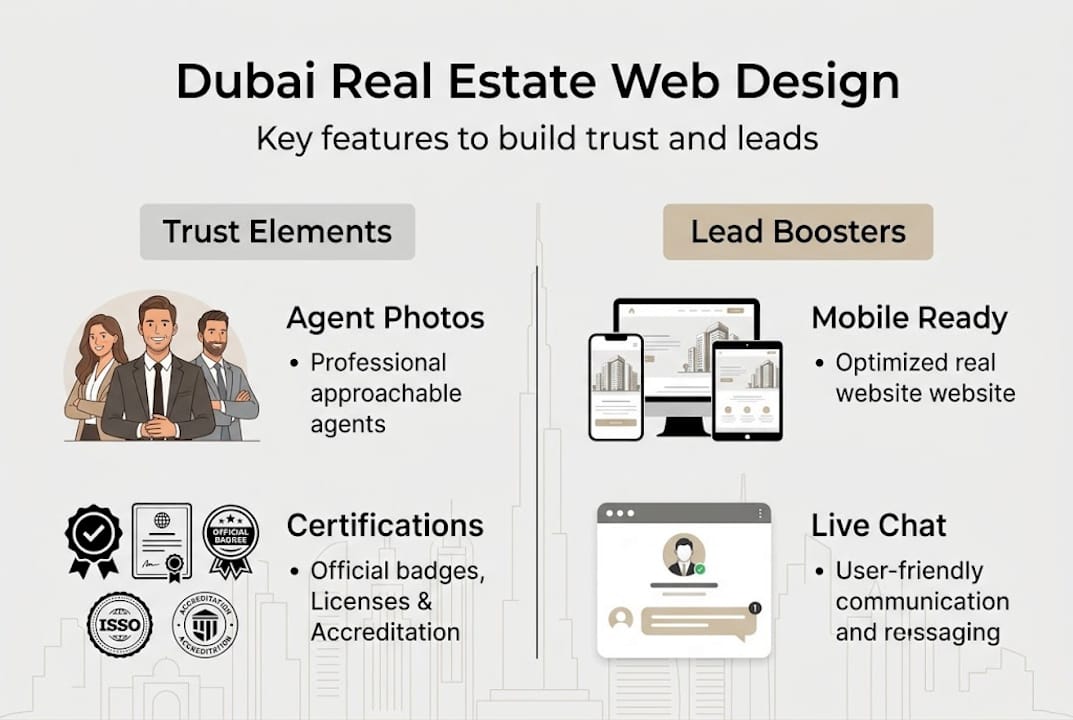
- Professional logo placement in the top-left corner signals a structured, credible business
- Agent bio photos with names and credentials make the team feel real and approachable
- Client testimonials with specific outcomes (not vague praise) dramatically increase confidence
- Certification badges and awards provide third-party validation
- Cluttered layouts or inconsistent fonts signal disorganization and reduce perceived expertise
Beyond visuals, responsiveness matters. A buyer who has a question at 10 PM on a Friday should not have to wait until Monday for an answer. AI chatbots and CRM integration turn real estate websites into 24/7 agents, increasing perceived professionalism and capturing leads around the clock.
“Your website should work like your best agent: always available, always knowledgeable, always moving prospects forward. The agencies that treat their site as a living sales tool are the ones that dominate their market.”
Learning from virtual agent best practices in other property markets shows that integrating live chat and automated follow-up can reduce response time from hours to seconds, which is exactly what high-intent buyers expect.
Pro Tip: Stick to two or three brand colors and one or two font families across your entire site. Mixing too many colors or fonts signals chaos and quietly erodes the premium perception you are trying to build.
A well-designed site also fuels referral and repeat business. When a client has a smooth, professional experience on your website, they remember it. They share it. In Dubai’s relationship-driven property market, that word-of-mouth amplification is worth far more than any paid ad. A website redesign that converts is not just about aesthetics. It is about building a reputation that compounds.
From visitor to client: Turning traffic into real estate leads
Getting visitors to your site is only half the equation. Converting them into leads requires intentional design decisions that guide behavior without feeling pushy.
Here are the key features every Dubai real estate website should implement:
- Clear calls-to-action on every page, including listing pages and blog posts
- Instant chat or a visible WhatsApp button for buyers who want fast answers
- Personalized inquiry forms that ask relevant questions based on property type or buyer intent
- Visible phone numbers in the header, not buried in a contact page
- Interactive maps showing property location relative to schools, metro stations, and lifestyle amenities
Once a visitor submits a form or starts a chat, the work does not stop. Lead nurturing is where most agencies lose momentum. Key follow-up steps include:
- Immediate auto-response confirming receipt of inquiry
- Personalized follow-up email within 24 hours
- CRM tagging to segment leads by budget, area, and timeline
- Scheduled touchpoints through email or SMS over the following weeks
Pro Tip: Refresh your testimonials and featured listings at least once a month. Stale content signals inactivity, while fresh updates show you are active and in demand. This small habit directly supports UI/UX best practices that keep return visitors engaged.
Continuous experimentation and A/B testing identify the best-performing strategies for converting real estate leads. Testing two versions of a contact form, a listing page layout, or a call-to-action button color may seem minor. But those incremental gains compound into significantly higher conversion rates over a 12-month period.
Dubai buyers expect a seamless, premium digital experience that mirrors the quality of the properties being sold. Every friction point you remove from the inquiry process is a direct increase in your conversion opportunity.
Our perspective: What most real estate sites get wrong—and how to fix it
After working with real estate professionals across Dubai for years, the pattern is clear: most agencies invest heavily in the launch of a website and almost nothing in its evolution. The site goes live, looks great for a few months, and then quietly stagnates while competitors improve.
This “set-and-forget” mindset is the single biggest conversion killer in Dubai real estate web design. A website is not a brochure. It is a living sales tool that needs real user feedback, analytics review, and regular updates to stay sharp. Ignoring this is like opening a showroom and never updating the display.
The agencies that consistently outperform their competitors treat their websites like digital sales offices, always open, always improving, always learning from visitor behavior. Check your analytics monthly. Test your contact forms. Ask recent clients where they first found you and what almost stopped them from inquiring.
Innovative web design for real estate is not about chasing trends. It is about building a disciplined habit of small improvements that deliver compounding returns. Start there.
Elevate your real estate business with expert web design in Dubai
The strategies covered here are not theoretical. They are the practical building blocks of high-performing real estate websites that generate consistent leads and build lasting brand authority in Dubai’s property market. Whether you are launching a new site or upgrading an existing one, the right design partner makes all the difference.
At DubaiWebCity, we specialize in creative web design solutions built specifically for ambitious Dubai businesses. From responsive website design services that perform flawlessly on any device to full digital strategy consultations, our team has the experience to turn your website into your strongest sales asset. Ready to start? Explore what our web design Dubai experts can build for your real estate brand.
Frequently asked questions
How does web design affect real estate lead generation in Dubai?
A well-designed website increases buyer trust and removes barriers to inquiry, directly boosting lead volume for Dubai real estate agencies.
Why is mobile optimization crucial for real estate websites?
Over half of Dubai’s property buyers search on their phones, so responsive design on mobile captures more visitors and converts them into leads before they bounce.
What design features build trust with real estate clients?
Agent photos, client testimonials, certification badges, and live chat tools all strengthen credibility and encourage high-intent buyers to reach out.
Can web design alone increase property sales?
Continuous A/B testing and thoughtful design work together to drive more inquiries and shorten the path from visitor to signed client.
Recommended
- Best Real Estate Website Design Company Dubai – Web Design Dubai – Website Design Company Dubai | NetSoft
- Responsive Website Design in Dubai – Web Design Dubai – Website Design Company Dubai | NetSoft
- Driving Digital Success: Expert Web Design, Web Development, and Digital Marketing Services in Dubai – Web Design Dubai – Website Design Company Dubai | NetSoft
- Top Web Designing Companies in Dubai: Elevate Your Online Presence – Web Design Dubai – Website Design Company Dubai | NetSoft
- Netthybel.no | Bestill Digital Visning og Virtuell Visning av Bolig – 3D Visning med Matterport