Most Dubai small business owners assume their website is working fine because it looks good on a desktop screen. But subtle design gaps, especially around mobile usability and accessibility, quietly push visitors away before they ever engage. Mobile conversion rates sit at just 2.3%, compared to 2.8% on desktop, and that gap grows wider when your site isn’t built for Dubai’s diverse, mobile-first audience. This guide breaks down the exact web design decisions that drive real user engagement, what mistakes are costing you customers, and how to fix them with practical, locally relevant strategies.
Table of Contents
- Why web design is crucial for user engagement
- Key web design elements that drive engagement
- Responsive and accessible design: Essential for Dubai SMEs
- Common Dubai web design pitfalls and how to avoid them
- Our take: Localizing web design for Dubai’s unique market
- Ready to enhance your user engagement? Explore top Dubai web design solutions
- Frequently asked questions
Key Takeaways
| Point | Details |
|---|---|
| Design impacts engagement | Every detail of your website’s design can increase or decrease user interaction and conversions. |
| Mobile and accessibility matter | Optimizing for mobile and accessible design expands your audience and boosts business results. |
| Localization drives results | Websites tailored to Dubai cultures and languages consistently see higher user engagement. |
| Avoid common pitfalls | Simple mistakes in content, responsiveness, or design can quietly hurt your online success. |
Why web design is crucial for user engagement
User engagement isn’t just about people spending time on your site. It’s a cluster of measurable behaviors: bounce rate, session duration, pages visited per session, click-through rates on calls to action, and ultimately, conversions. Each of these metrics tells you whether your design is pulling visitors in or pushing them out.
For Dubai SMEs, these numbers carry real weight. A restaurant in JBR, a boutique retailer in Dubai Mall, or a logistics firm in JAFZA all compete in one of the world’s most digitally active markets. Visitors expect speed, clarity, and a seamless experience. If your site delivers friction instead, they leave. Fast.
Research confirms what experienced designers already know: mobile conversion rates are 2.3%, noticeably lower than the 2.8% seen on desktop. That gap isn’t accidental. It reflects poor mobile optimization, slow load times, and layouts that weren’t built with thumb-scrolling in mind. Understanding UX impact on SMB growth is the first step toward closing that gap.
Here’s a quick look at how design quality maps to engagement outcomes:
| Design quality | Bounce rate | Avg. session time | Conversion likelihood |
|---|---|---|---|
| Poor (cluttered, slow) | High (70%+) | Under 1 minute | Very low |
| Average (basic, functional) | Moderate (50-65%) | 1-2 minutes | Moderate |
| Strong (clear, fast, mobile-ready) | Low (under 40%) | 3+ minutes | High |
The industries most affected in Dubai include:
- Tourism and hospitality: Visitors book based on visual trust. A slow or cluttered site kills that trust instantly.
- Food and beverage: Mobile menus and online ordering must be frictionless or customers order elsewhere.
- Retail and e-commerce: Product discovery depends on clean navigation and fast load times.
- Professional services: First impressions determine whether a prospect calls or clicks away.
Good design isn’t decoration. It’s the mechanism through which your brand earns trust and converts curiosity into action. Exploring UI/UX business growth strategies can help you understand how these principles apply directly to your sector.
Key web design elements that drive engagement
Not all design choices carry equal weight. Some elements are purely cosmetic. Others directly determine whether a user stays, clicks, or converts. Knowing the difference is what separates high-performing Dubai websites from the ones that look nice but don’t deliver results.
The core elements that move the needle on engagement are:
- Navigation: If users can’t find what they need within two clicks, they leave. Simple, labeled menus beat clever icon-only designs every time.
- Visual hierarchy: Your most important content should be the most visually prominent. Headlines, subheadings, and CTAs need clear size and contrast differentiation.
- Whitespace: Empty space isn’t wasted space. It guides the eye and reduces cognitive load.
- CTA placement: Calls to action buried below the fold or hidden in small text get ignored. Place them where the user’s eye naturally lands.
- Load time: Every additional second of load time reduces conversions. This is non-negotiable in a market as competitive as Dubai.
Visual clutter overloads cognition, which directly hurts engagement. When a page tries to say everything at once, the user processes nothing and bounces. Applying design thinking principles helps you prioritize what truly matters to your audience.
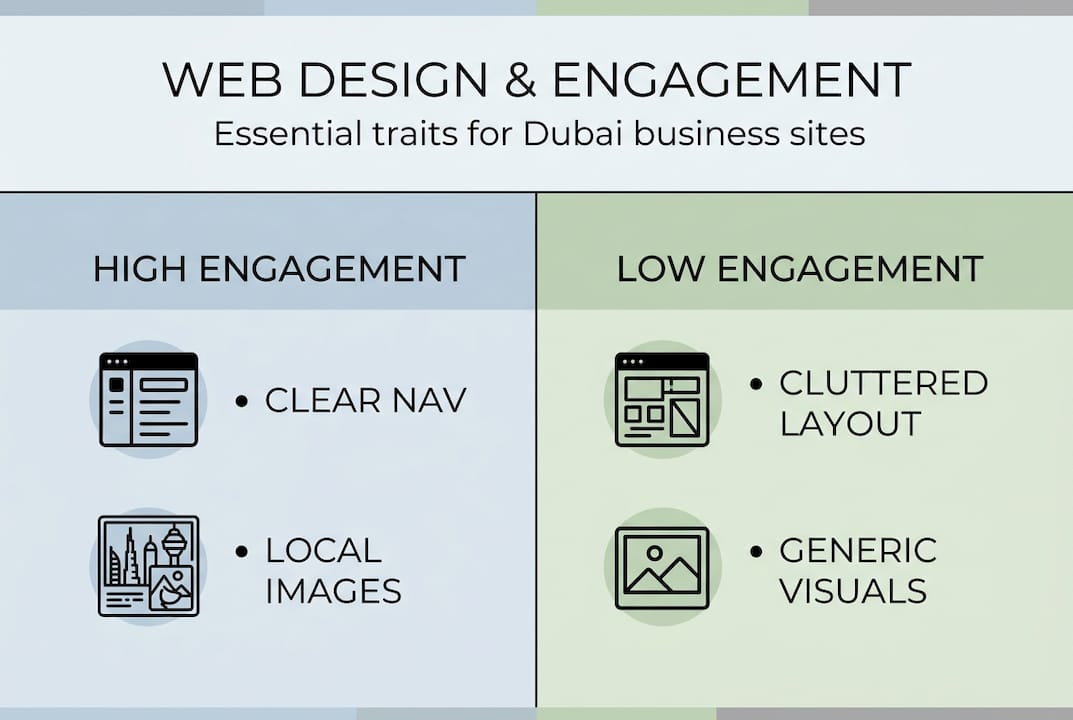
Here’s a comparison of high-engagement versus low-engagement design attributes:
| Attribute | High engagement | Low engagement |
|---|---|---|
| Navigation | Clear, labeled, max 5 items | Overcrowded, icon-only |
| Visual hierarchy | Strong contrast, clear focal points | Flat, everything looks equal |
| Load speed | Under 3 seconds | 5+ seconds |
| CTA visibility | Above the fold, high contrast | Buried, low contrast |
| Whitespace | Generous, intentional | Minimal, cluttered |
For Dubai’s hospitality and retail sectors specifically, visual appeal carries extra weight. A hotel website needs stunning imagery with fast load times. A fashion retailer needs clean product grids with minimal distractions. Exploring creative design ideas tailored to your industry can spark the right direction. If your current site isn’t performing, redesign strategies built around conversion goals are worth prioritizing.

Pro Tip: Run a five-second test with someone unfamiliar with your business. Show them your homepage for five seconds, then ask what your business does and what they should do next. If they can’t answer both questions, your visual hierarchy needs work.
Responsive and accessible design: Essential for Dubai SMEs
Responsive design means your website automatically adjusts its layout, text size, and image scaling to fit any screen, whether that’s a desktop monitor, a tablet, or a smartphone. In Dubai, where smartphone penetration is among the highest in the world, this isn’t optional. It’s the baseline.
But responsiveness alone isn’t enough. Accessibility is the next layer, and most Dubai SMEs skip it entirely. Accessibility means designing so that users with visual, motor, or cognitive disabilities can still use your site effectively. This includes:
- Sufficient color contrast between text and background
- Text that scales without breaking layout
- Alt text on all images for screen readers
- Keyboard navigation support for users who can’t use a mouse
- Clear focus indicators on interactive elements
16% of users may have disabilities that affect how they engage with your site. That’s not a small edge case. That’s roughly one in six of your potential customers. Ignoring accessibility doesn’t just exclude users; it shrinks your addressable market.
The good news is that accessible design almost always improves the experience for everyone. Larger text, better contrast, and cleaner navigation benefit users with aging eyes just as much as those using assistive technology. Review UI/UX accessibility tips to find quick wins your team can implement without a full redesign.
“Designing for accessibility isn’t charity. It’s smart business. Every barrier you remove is a customer you keep.”
For responsive design specifically, the key practices are:
- Use flexible grid layouts that reflow content naturally
- Set images to scale within their containers
- Test on real devices, not just browser emulators
- Ensure tap targets (buttons, links) are at least 44px tall for easy thumb tapping
Investing in responsive design in Dubai means your site performs well regardless of how your customer finds you. That consistency builds trust and keeps bounce rates low.
Pro Tip: Use Google’s free Lighthouse tool to audit your site for both performance and accessibility. It scores your site out of 100 and gives specific, actionable recommendations you can hand directly to your developer.
Common Dubai web design pitfalls and how to avoid them
Even well-intentioned web design projects fall into predictable traps. In Dubai’s market, a few specific mistakes come up again and again, and each one quietly erodes engagement and revenue.
Here are the most critical design mistakes Dubai SMEs make:
- Building for desktop first: Designing on a large monitor and then trying to squeeze the layout into mobile almost always produces a broken mobile experience. Start with mobile, then scale up.
- Ignoring bilingual requirements: Dubai’s audience is genuinely bilingual. A site that only works in English, or offers a broken Arabic version, immediately alienates a large segment of your market.
- Poor dynamic content display: Menus, promotions, and product listings that look perfect with placeholder text often break when real content is added. Localization and dynamic content can shatter a pixel-perfect design if it wasn’t built to handle real-world variability.
- Neglecting page speed on mobile networks: Even with good 5G coverage in Dubai, page weight matters. Uncompressed images and bloated scripts slow everything down.
- Skipping user testing with local audiences: Designs tested only by the development team miss cultural nuances, language preferences, and local browsing habits that real Dubai users notice immediately.
The costs of these mistakes are tangible. Higher bounce rates mean lower SEO rankings. Poor mobile experience means lost sales. A broken Arabic layout means you’ve excluded a core audience segment. Following a proven SMB website workflow helps you avoid these traps from the start rather than patching them later.
Practical fixes include switching to a mobile-first design process, using a translation management system for Arabic/English content, stress-testing layouts with real content before launch, and compressing all images to under 200KB where possible. Reviewing UI/UX best practices gives you a structured checklist to work through systematically.
Pro Tip: Before launching any redesign, recruit five real Dubai residents from your target demographic to test the site on their own phones. Watch where they hesitate, where they tap the wrong thing, and where they give up. That session will reveal more than any analytics dashboard.
Our take: Localizing web design for Dubai’s unique market
Most web design guides treat localization as translation. Add Arabic text, flip the layout to right-to-left, done. We’ve worked with Dubai businesses long enough to know that approach misses the point entirely.
Real localization means your site feels like it was made for Dubai, not adapted for it. That means using imagery that reflects the actual visual culture of the city, referencing local landmarks and seasons where relevant, and understanding that Dubai’s audience is genuinely multicultural, not just Arabic-English bilingual. Your design needs to resonate with a Filipina nurse in Deira, an Indian entrepreneur in Business Bay, and an Emirati family in Mirdif simultaneously.
Conventional imported design thinking, usually built around Western browsing habits, often fails here. It prioritizes pixel-perfection over functional flexibility. But a site that looks flawless in a Figma mockup and breaks when real Arabic content is loaded is not a good design. It’s a fragile one. Applying genuine local design thinking means building for the content and the audience you actually have, not the idealized version.
Engagement in Dubai comes from websites that feel present and specific, not generic and imported.
Ready to enhance your user engagement? Explore top Dubai web design solutions
If the strategies in this guide resonated with you, the next step is putting them into practice with a team that understands Dubai’s market from the inside out.
At DubaiWebCity, we’ve been building high-performance websites for Dubai SMEs since 2004. We specialize in creative web design services that go beyond aesthetics to deliver real engagement and measurable results. Whether you need a full redesign or targeted improvements to your existing site, our responsive website design solutions are built specifically for Dubai’s mobile-first, bilingual audience. Reach out today for a consultation and let’s build something that actually works for your customers.
Frequently asked questions
How does web design directly impact user engagement?
Web design shapes first impressions, makes navigation intuitive, and guides visitors toward action, directly influencing bounce rates and conversions. A well-structured site keeps users engaged longer and makes them more likely to convert.
Why is mobile-friendly design so important for Dubai businesses?
With mobile conversion rates at 2.3%, compared to 2.8% on desktop, a site that isn’t optimized for mobile is already losing a significant share of potential customers. In Dubai’s smartphone-heavy market, mobile performance is a revenue issue, not just a design preference.
What are the biggest accessibility mistakes Dubai SMEs make in web design?
The most common mistakes are poor color contrast, missing alt text on images, and no keyboard navigation support, collectively excluding up to 16% of potential users who have disabilities affecting how they browse.
How can localization improve user engagement on Dubai websites?
Localization improves engagement by adapting not just language but also visual style, cultural references, and context-aware content to match what Dubai’s diverse audience actually expects when they land on your site.