TL;DR:
- Website speed influences consumer trust, bounce rates, and online sales for Dubai SMBs.
- Fast-loading sites improve SEO rankings and increase visibility in mobile searches.
- Common speed issues include poor hosting, excessive plugins, and unoptimized images.
Seventy percent of consumers say page speed directly influences their decision to buy from an online business. For Dubai’s small and medium-sized business owners, that number is not just a statistic — it’s a revenue alarm. Your website is often the first interaction a potential customer has with your brand, and if it loads slowly, that first impression costs you. Users abandon websites that take more than 3 seconds to load, meaning every extra second is a customer walking out the digital door. This guide breaks down exactly why speed matters, what’s slowing your site down, and what you can do about it right now.
Table of Contents
- How website speed affects user experience
- Website speed’s impact on SEO and online visibility
- Technical reasons websites slow down (and what to do)
- Best practices to improve website speed for Dubai SMBs
- Why speed is non-negotiable for Dubai SMBs: Our take
- Let’s help you build a faster website
- Frequently asked questions
Key Takeaways
| Point | Details |
|---|---|
| Speed reduces bounce rate | Faster sites keep more visitors from leaving instantly. |
| SEO boost via speed | Google and Bing rank faster sites higher, attracting more traffic. |
| Fix slowdowns quickly | Tackle technical issues like unoptimized images and excessive plugins for fast results. |
| Continuous improvement matters | Regularly testing and refining your site speed maintains a competitive edge. |
How website speed affects user experience
Human patience online is shorter than most people realize. Research in behavioral psychology shows that users form an opinion about a website within 50 milliseconds of arrival. If your page hasn’t loaded in that window, the opinion they form is negative by default. Speed isn’t just a technical metric — it shapes how customers feel about your brand before they’ve read a single word.
Website speed directly impacts user experience by reducing bounce rates and increasing retention. A bounce happens when a visitor lands on your page and leaves without clicking anything. For Dubai retail, hospitality, or service businesses that rely on website inquiries, a high bounce rate is essentially a leaking sales funnel.
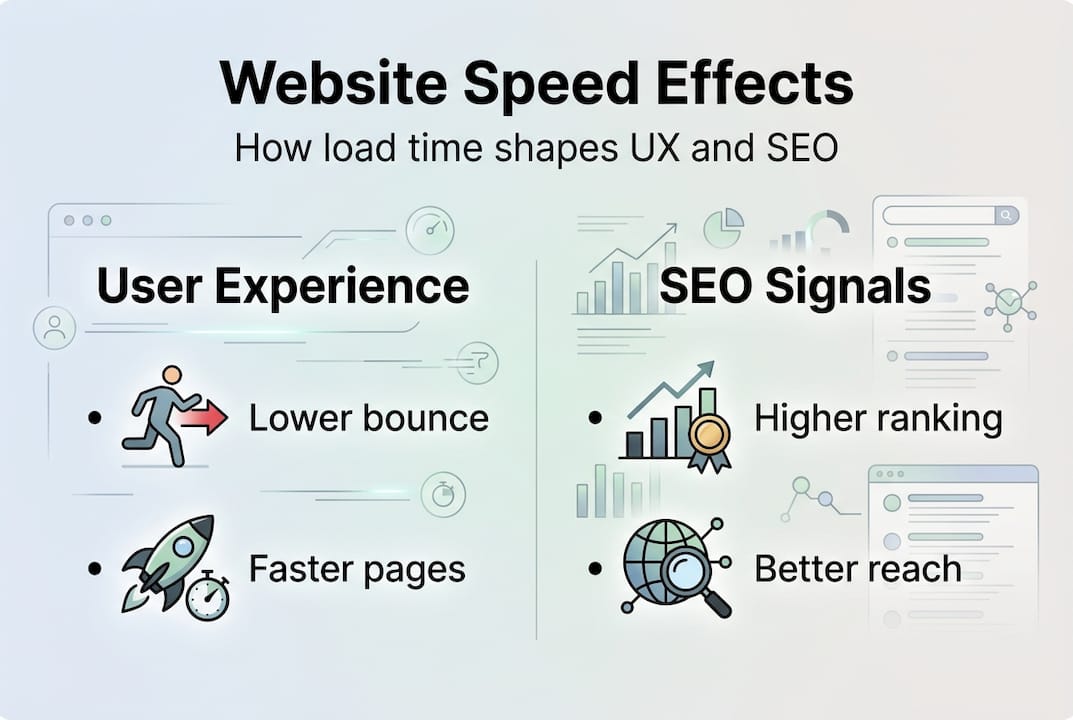
Here’s how load time directly affects user behavior:
| Load time | Bounce rate increase | User perception |
|---|---|---|
| Under 2 seconds | Baseline | Fast and trustworthy |
| 3 seconds | +32% | Acceptable but risky |
| 5 seconds | +90% | Frustrating |
| 10 seconds | +123% | Abandoned |
Think of your website like a Dubai shopping mall. If the entrance is jammed and it takes five minutes just to get inside, most visitors turn around and head to the mall next door. Your competitors are always one click away.
“Every 100ms delay in load time can reduce conversions by up to 1%. For high-traffic sites, that adds up fast.”
For Dubai SMBs competing in sectors like real estate, retail, food delivery, or professional services, the math is brutal. Even a modest site generating 5,000 monthly visitors loses significant potential revenue if just 30% more visitors bounce because of slow load times.
The good news: small improvements make a big difference. Applying solid UI/UX best practices around layout and load order can make your site feel faster even before you touch the server.
Pro Tip: Run your site through Google PageSpeed Insights right now. If your score is below 70 on mobile, you have a measurable problem worth fixing this week.
Quick wins to reduce perceived load time:
- Lazy-load images below the fold
- Display text content before images
- Use skeleton screens instead of blank white loading states
- Minimize third-party scripts (chat widgets, trackers) that block rendering
Website speed’s impact on SEO and online visibility
User experience is just the beginning — let’s see how speed influences whether customers find you in the first place.
Google made page speed an official ranking factor in 2010 for desktop and extended it to mobile searches in 2018. Since then, speed is universally positive for SEO across every empirical study on the topic. A slow website doesn’t just frustrate visitors — it actively signals to search engines that your site delivers a poor experience, which pushes you further down the results page.

For Dubai SMBs, this is critical. Most local searches happen on mobile devices. A user searching “interior designers in Dubai” or “business setup consultants JLT” is probably on their phone during a commute or lunch break. If your mobile site takes 6 seconds to load, Google already knows this — and it factors that into where your site appears.
Fast vs. slow sites: SEO comparison
| Factor | Fast site (under 2s) | Slow site (over 5s) |
|---|---|---|
| Google ranking signals | Positive | Negative |
| Mobile search visibility | High | Reduced |
| Core Web Vitals score | Passes | Fails |
| Crawl budget efficiency | Maximized | Wasted |
| Average session duration | Longer | Shorter |
Core Web Vitals — Google’s framework measuring real-world user experience — include Largest Contentful Paint (how fast main content loads), First Input Delay (how quickly the site responds), and Cumulative Layout Shift (visual stability). Failing these benchmarks is now a direct ranking disadvantage.
The compounding effect is what most SMBs miss. A slow site means fewer organic visitors, which means fewer conversions, which means less revenue to reinvest in marketing. The cycle hurts growth over time. Learning about SEO in Dubai is step one, but without speed, your SEO efforts underperform.
Four technical SEO fixes tied to speed:
- Enable browser caching so repeat visitors load your site faster
- Minify CSS, JavaScript, and HTML to remove unnecessary code
- Use a Content Delivery Network (CDN) to serve files from servers closer to your users
- Switch to a faster hosting plan if your Time to First Byte (TTFB) exceeds 600ms
Reading about SEO optimization for Dubai SMBs will give you a deeper picture of how these technical elements tie into your broader visibility strategy.
Pro Tip: Check your Core Web Vitals inside Google Search Console under the “Experience” tab. It tells you exactly which pages are failing and why — no guesswork needed.
Technical reasons websites slow down (and what to do)
With SEO and user impact clear, let’s see where most SMB websites falter — and how to fix bottlenecks.
Slow server response, render-blocking JavaScript and CSS, and unoptimized images are the most frequent culprits in SMB websites, especially WordPress setups. Understanding each one helps you prioritize where to focus your energy.
The most common speed killers for Dubai SMBs:
- Cheap shared hosting: Your site shares server resources with hundreds of others. During traffic peaks, everyone slows down. Dubai businesses with UAE-based or regional hosting often experience this problem acutely.
- Too many plugins: A WordPress site with 40 active plugins is a performance nightmare. Each plugin loads scripts, stylesheets, and database queries that stack up.
- Unoptimized images: A homepage hero image saved at 4MB instead of 200KB can alone add 3 to 4 seconds to your load time.
- Render-blocking code: JavaScript files that load in the document head force the browser to pause rendering until those files download completely.
- No caching layer: Without caching, every visitor request regenerates the full page from scratch, hammering your server.
WordPress is the world’s most popular CMS, and it’s a common choice for Dubai SMBs because of its flexibility. But it’s also easy to bloat. A theme with a heavy page builder, combined with aggressive plugin usage and no performance optimization, creates a site that feels modern visually but loads like it’s from 2005.
If you’re planning a site overhaul, considering solid website redesign strategies from the start prevents these technical debts from accumulating. Similarly, if you’re launching something new, understanding the website launch steps that include performance benchmarking will save you expensive fixes later.
Pro Tip: Install a free tool like Query Monitor on your WordPress site to identify which plugins and database queries are adding the most load time. You may find one plugin responsible for 40% of the slowdown.
Quick wins for this week:
- Compress all images using a tool like ShortPixel or TinyPNG
- Deactivate and delete any plugin you haven’t used in 90 days
- Enable GZIP compression on your server
- Move to a managed WordPress host or a VPS plan if you’re still on shared hosting
Best practices to improve website speed for Dubai SMBs
Knowing what slows you down gives you power — here’s how Dubai SMBs can get fast, stay fast, and win online.
Users expect pages to load in under 2 to 3 seconds, and abandonment rates climb sharply beyond that threshold. Meeting this expectation in 2026 requires a structured approach, not one-off fixes.
Five steps to build a faster Dubai business website:
- Audit your current speed. Use Google PageSpeed Insights, GTmetrix, or WebPageTest to measure your baseline. Note your mobile and desktop scores separately — they often differ significantly.
- Compress and resize images. Convert images to next-generation formats like WebP. Aim for images under 100KB wherever possible. Hero banners can go to 300KB if absolutely necessary.
- Streamline your codebase. Remove unused CSS and JavaScript. Use a plugin like WP Rocket or Perfmatters if you’re on WordPress. For custom builds, review your code with a developer.
- Host smart. Choose hosting with servers located in or close to the UAE. Look for plans with SSD storage, NGINX server architecture, and a built-in CDN. These directly reduce your TTFB.
- Monitor continuously. Speed is not a one-time fix. Set up monthly checks using UptimeRobot or Google Search Console alerts so you catch regressions early.
Mobile-first design is no longer optional. More than 60% of UAE internet traffic comes from smartphones. Reviewing website design tips that prioritize mobile performance gives your business a structural advantage over competitors who treat mobile as secondary.
For a step-by-step workflow tailored to Dubai conditions, the responsive website workflow guide walks through how to build speed into your design process from day one. And if budget is a concern, budget website strategies for small businesses show that a fast site doesn’t require a massive investment.
Pro Tip: After making speed improvements, run a new PageSpeed Insights test and compare your Largest Contentful Paint score before and after. Even a 1-second improvement in LCP typically correlates to a 10 to 15% reduction in bounce rate.
Why speed is non-negotiable for Dubai SMBs: Our take
Most performance guides stop at the technical checklist. But after two decades of building websites for businesses across Dubai and the UAE, we’ve observed something that data alone doesn’t fully capture: speed builds trust, and trust closes deals.
The businesses that thrive online in Dubai are not necessarily the ones with the most beautiful sites. They’re the ones whose sites respond instantly, feel reliable, and never make a customer wait. That reliability signals professionalism in a market where consumers have high expectations and low tolerance for friction.
We’ve also seen the costly mistake of waiting until a site is “perfect” before optimizing for speed. Perfection delays launch. A fast, functional site that goes live now will outperform a slow, polished one that launches six months later. Your competitors are not waiting for perfect.
Consumer expectations in Dubai are rising every year. The UAE’s digital infrastructure is world-class, and users here are accustomed to instant connectivity. A slow website feels like a broken promise in this environment. Businesses that invest in website development for SMBs with speed as a core requirement are not just fixing a technical problem — they’re building a competitive edge that compounds over time.
Speed is not a feature. It’s the foundation.
Let’s help you build a faster website
If your site is losing visitors because of slow load times, DubaiWebCity can help you fix that — and build for the long term.

With over 20 years of experience designing and developing websites for Dubai businesses, our team knows exactly where performance gaps hide and how to close them. We offer responsive website design built for speed from the ground up, paired with SEO services in Dubai that amplify your visibility once your performance improves. If you want fresh ideas for your site’s design, explore our creative web design ideas to see what a modern, fast-loading website looks like. Book a free consultation with our team today and find out exactly what’s holding your site back.
Frequently asked questions
What is a good website load time?
A good website load time is under 2 to 3 seconds. Most users abandon sites that take longer, making sub-3-second loading a critical benchmark for any business website.
How does website speed improve SEO?
Fast websites rank higher because Google and Bing use speed as a direct ranking signal, particularly for mobile searches. Speed is universally positive for SEO performance across all empirical research on the subject.
What slows most SMB sites down?
The biggest culprits are cheap shared hosting, too many plugins, and unoptimized images. Slow server response and render-blocking resources are especially common in WordPress-based business websites.
How do I check my website speed?
Use Google PageSpeed Insights or GTmetrix for a free, detailed speed score with specific recommendations. Both tools show separate mobile and desktop results so you can prioritize which issues to address first.
Recommended
- UI/UX tips that boost Dubai SMB engagement in 2026
- Designing Website Like a Pro: Boost Your Conversions With These Website Design Tips! – Web Design Dubai – Website Design Company Dubai | NetSoft
- How to improve website UI and UX for better engagement
- 6 Essential UI UX Best Practices for Dubai Web Designers
- Website-Optimierung: Mehr Sichtbarkeit, Umsatz & Effizienz