Many business owners think UX is just another word for making websites look pretty. That’s UI. UX goes deeper, shaping how visitors interact with your site, find what they need, and ultimately decide to buy or bounce. For Dubai SMBs competing in a crowded digital market, understanding this distinction isn’t academic. It’s the difference between a website that converts and one that costs you customers. This article breaks down the core principles, research methods, and measurable benefits of UX design, showing you how to apply these strategies to boost engagement and drive real business growth in 2026.
Table of Contents
- Understanding The Role Of UX In Web Design For SMBs In Dubai
- Core UX Research Methodologies And Tools
- Designing For Edge Cases And Diverse Audiences In Dubai
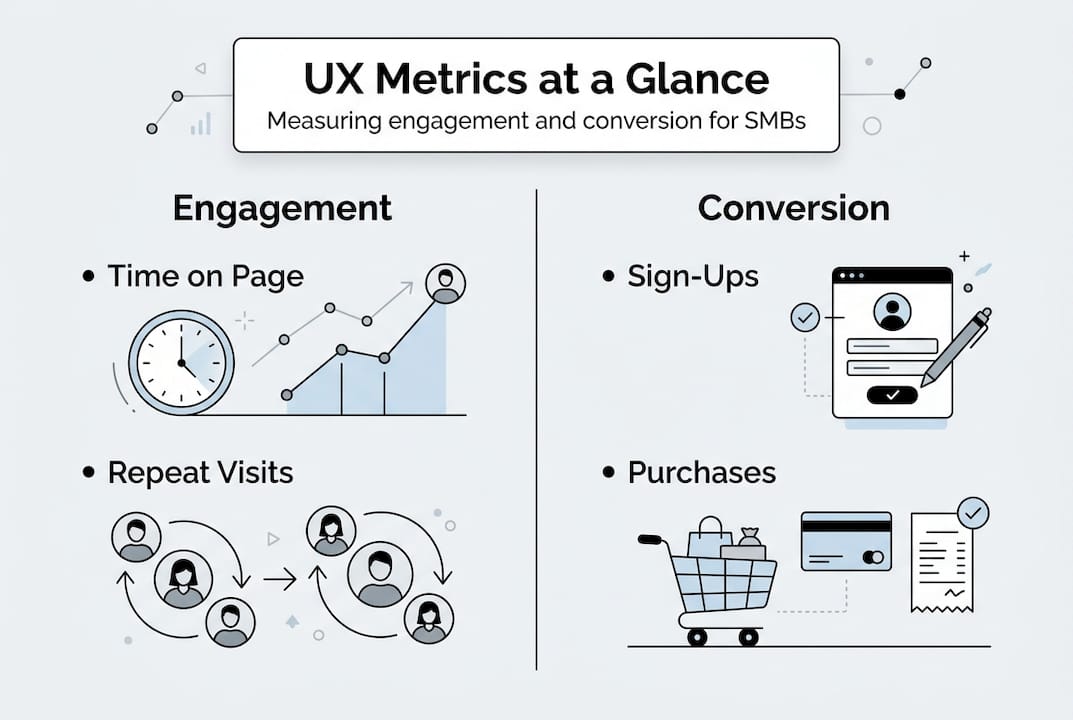
- Measuring UX Impact: Engagement, Conversion, And Usability Metrics
- Enhance Your SMB Website With Expert UX Design Services In Dubai
- Frequently Asked Questions
Key takeaways
| Point | Details |
|---|---|
| UX extends beyond visuals | User experience design is a research-driven process focusing on the entire user journey, not just interface aesthetics. |
| Research informs decisions | Methods like user interviews, surveys, and usability testing reveal what your audience actually needs and how they behave. |
| Edge cases build trust | Designing for unusual scenarios like slow networks or accessibility needs ensures reliability for Dubai’s diverse user base. |
| Metrics prove value | Track engagement rates, conversion improvements, and repeat visitor behavior to measure UX impact on your bottom line. |
| Professional support accelerates results | Partnering with experienced UX agencies helps Dubai SMBs implement proven strategies faster and more effectively. |
Understanding the role of UX in web design for SMBs in Dubai
UX design focuses on creating seamless, user-centered experiences that align business objectives with what visitors actually want. It’s not about making things look good. That’s UI. UX maps the entire journey from landing page to checkout, identifying friction points and optimizing each interaction. For Dubai SMBs, this means understanding how your target customers think, what motivates their decisions, and where they get stuck.
The distinction matters because you can have a beautiful website that frustrates users. Clean design with confusing navigation. Stunning visuals with slow load times. UI handles colors, fonts, and button styles. UX determines whether visitors can find your contact form, understand your value proposition, or complete a purchase without calling support. Both matter, but UX comes first because it defines the structure UI will beautify.
User psychology drives effective UX. People scan pages in F-shaped patterns. They expect certain elements in predictable places. They abandon sites that don’t load within three seconds. Journey mapping reveals these patterns by documenting every touchpoint from first click to final conversion. You discover where prospects hesitate, which features confuse them, and what information they need at each stage.
Consider a Dubai restaurant wanting online reservations. Poor UX might bury the booking button, require account creation before showing availability, or fail to confirm reservations clearly. Good UX places booking prominently, shows real-time availability immediately, and sends instant confirmation with calendar integration. Same business, same menu, vastly different customer satisfaction.
Pro Tip: Map your customer journey quarterly by walking through your site as a first-time visitor. Note every moment of confusion or delay. Those friction points are costing you conversions.
For SMBs competing in Dubai’s fast-moving market, UX becomes a competitive advantage. When two companies offer similar products at similar prices, the one with smoother checkout wins. The one with clearer product information gets more inquiries. The one that works flawlessly on mobile captures the 70% of Dubai traffic browsing on phones. UX isn’t a luxury. It’s table stakes for digital growth in 2026.
Core UX research methodologies and tools
Effective UX starts with understanding who uses your site and why. Key methodologies include user research, design thinking, information architecture, wireframing, prototyping, and iterative testing. Each serves a specific purpose in building experiences that work for real people, not assumptions.
User research splits into two categories. Generative research explores problems and opportunities through open-ended questions. You’re discovering what users need before designing solutions. Evaluative research tests specific designs to see if they work. You’re validating decisions with real feedback. Both matter, but generative comes first because you can’t solve problems you haven’t identified.
Qualitative methods like user interviews reveal the why behind behavior. You learn that customers abandon carts not because of price but because shipping costs appear too late. Quantitative methods like surveys show how many people experience each issue. You discover 60% of mobile visitors can’t find your phone number. Combining both gives you complete insight into what to fix and how many people it affects.
Design thinking provides a structured framework for turning research into solutions:
- Empathize with users through interviews, observation, and journey mapping to understand their real needs and frustrations.
- Define the core problem by synthesizing research into clear problem statements that guide design decisions.
- Ideate multiple solutions through brainstorming sessions that explore different approaches without immediate judgment.
- Prototype quick, low-fidelity versions of promising ideas to test concepts before investing in full development.
- Test prototypes with actual users, gather feedback, and refine designs based on what works and what doesn’t.
This design thinking process prevents expensive mistakes by validating ideas early. You discover navigation confusion with paper sketches instead of after launching a redesigned site.
Wireframing translates concepts into visual structure. These basic layouts show where elements go without getting distracted by colors or images. You’re solving information hierarchy and interaction flow. Does the call-to-action appear above the fold? Can users access key features within three clicks? Wireframes answer these questions cheaply.
Prototyping adds interactivity to wireframes. Users can click through flows, test features, and experience the site before development begins. Tools like Figma and Adobe XD let you create realistic prototypes in hours. You identify usability issues when fixing them costs time, not money.
| Research Type | Purpose | Common Methods | When to Use |
|---|---|---|---|
| Generative | Discover user needs | Interviews, field studies, diary studies | Beginning of projects or exploring new features |
| Evaluative | Test design effectiveness | Usability testing, A/B testing, analytics review | After initial designs or before launch |
| Qualitative | Understand motivations | One-on-one interviews, focus groups, observation | When you need depth over breadth |
| Quantitative | Measure patterns | Surveys, analytics, heat maps | When you need statistically significant data |
Pro Tip: Start small with guerrilla testing. Grab five people from your target audience, show them your prototype for 15 minutes, and watch where they struggle. You’ll uncover 80% of usability issues with minimal investment.
Iterative testing closes the loop. You launch, measure, learn, and improve continuously. Analytics show where users drop off. Heat maps reveal what they click. Session recordings expose confusion. Each insight informs the next round of improvements. UX never finishes because user needs evolve and your business grows.
Designing for edge cases and diverse audiences in Dubai
Edge cases are unusual scenarios most designers ignore. A user with a screen reader. Someone on a 3G connection. A customer entering an apartment number in the address field. These situations seem rare until you realize they affect 10-20% of your audience. Designing for edge cases first builds trust and reveals product weaknesses before they cost you customers.
Dubai’s population creates unique challenges. You’re serving Emiratis, expats from 200+ countries, tourists, and business travelers. Language preferences vary. Cultural expectations differ. Device capabilities range from the latest iPhone to budget Android phones. Network speeds fluctuate between fiber optic towers and crowded public WiFi. Ignoring this diversity means excluding potential customers.

Accessibility isn’t just good ethics. It’s good business. Designing for users with disabilities makes your site better for everyone. Captions help people watching videos in noisy environments. Keyboard navigation speeds up power users. High contrast benefits anyone in bright sunlight. The best practices that serve edge cases improve the mainstream experience.
Common edge cases Dubai SMBs should address:
- Slow or unstable network connections requiring progressive loading and offline functionality
- Multiple language support beyond English and Arabic for diverse expat communities
- Various input methods including touch, keyboard, voice, and assistive technologies
- Unusual but valid data like long names, non-Latin characters, or complex address formats
- Different screen sizes from small phones to large desktop monitors and everything between
Resilient design anticipates failure. What happens when an image doesn’t load? Does your layout break or does alt text appear? What if the payment gateway times out? Do users lose their cart or get clear recovery instructions? Building fallbacks for every critical interaction prevents frustration when things go wrong.
“Edge cases aren’t edge cases if they happen to 10% of your users. Design for the extremes first, and you’ll build something that works reliably for everyone in between. This approach reveals weaknesses early and builds trust with diverse audiences.”
Consider form validation. Standard design checks email format. Edge case design also handles:
- Email addresses with plus signs or multiple dots
- International phone numbers with varying lengths
- Names with apostrophes, hyphens, or single characters
- Addresses without street numbers or postal codes
Each accommodation seems minor until it blocks a real customer from completing a purchase. For Dubai SMBs serving international clients, these details separate professional sites from amateur ones.
Testing with diverse users catches edge cases before launch. Include participants with different abilities, devices, and network conditions. Watch someone navigate your site on a three-year-old phone over spotty WiFi. Observe a non-native English speaker trying to complete checkout. These sessions reveal assumptions you didn’t know you made.
Pro Tip: Create a testing checklist of edge cases specific to your Dubai audience. Include scenarios like Arabic text input, address formats from common expat countries, and mobile browsing during peak traffic hours when networks slow down.
Measuring UX impact: engagement, conversion, and usability metrics
You can’t improve what you don’t measure. UX metrics quantify how design changes affect business outcomes. Engagement rates show if visitors find your content valuable. Conversion rates prove whether your site turns browsers into buyers. Usability metrics reveal where people struggle. Together, they guide data-driven improvements instead of guessing.
Key performance indicators for UX success:
- Bounce rate measuring the percentage of visitors who leave after viewing one page
- Time on page indicating content relevance and engagement depth
- Pages per session showing how effectively your site encourages exploration
- Conversion rate tracking the percentage of visitors completing desired actions
- Task completion rate measuring how many users successfully finish specific goals
- Error rate counting how often users encounter problems or make mistakes
Empirical benchmarks show significant trends. Average website conversion rates declined from 2.4% in 2024 to 2.3% in 2025, but UX leaders maintain rates above 5%. The gap between good and average UX widens each year as user expectations rise. Dubai SMBs investing in UX gain competitive advantage while others fall behind.
Repeat visitors convert at dramatically higher rates than first-time visitors. Someone who returns to your site already trusts your brand and understands your navigation. They convert at 3-5 times the rate of new visitors. This makes retention metrics crucial. Are people bookmarking your site? Returning within 30 days? Subscribing to updates? These behaviors predict long-term revenue better than traffic volume.
| Metric | Industry Average 2026 | UX Leaders | Impact |
|---|---|---|---|
| Overall conversion rate | 2.3% | 5.1% | 122% improvement |
| Mobile conversion rate | 1.8% | 4.2% | 133% improvement |
| Repeat visitor conversion | 5.7% | 11.3% | 98% improvement |
| Average order value | Baseline | 15% higher | Direct revenue impact |
| Cart abandonment rate | 68% | 52% | 24% reduction |
AI traffic increasingly influences conversion patterns. Chatbots and voice assistants drive qualified traffic that converts 20% better than organic search. Users arriving via AI recommendations already have purchase intent. Optimizing for these channels means structuring content for featured snippets and conversational queries.
Usability testing provides qualitative depth that analytics miss. You see exactly where users get confused, what they expect but can’t find, and how they work around poor design. Five user tests uncover more actionable insights than analyzing 5,000 sessions. Combine both approaches for complete understanding.
Tracking improvements over time proves UX value to stakeholders. Document baseline metrics before redesigns. Measure the same KPIs monthly after launch. Calculate ROI by comparing conversion lift against design investment. When a $10,000 UX project increases monthly conversions by $3,000, payback happens in four months. Every month after that is pure profit.
Pro Tip: Set up conversion funnels in Google Analytics tracking each step from landing page to purchase. You’ll immediately see where most people drop off, focusing your UX efforts on the highest-impact improvements first.
For boosting conversions, combine quantitative metrics with qualitative insights. Heat maps show what people click. Session recordings reveal why they clicked it. User interviews explain what they expected to happen. This triangulation identifies root causes instead of symptoms, leading to solutions that actually work.
Enhance your SMB website with expert UX design services in Dubai
Applying these UX principles requires expertise, time, and tools most SMBs don’t have in-house. That’s where professional design partners make the difference. DubaiWebCity brings over 20 years of experience creating user-centered websites that drive measurable business results for Dubai companies across industries.
Our UI/UX design services combine research-driven strategy with creative execution tailored to your target audience. We start by understanding your business goals and customer needs, then design experiences that align both. From initial wireframes through iterative testing and post-launch optimization, we handle the complete UX process so you can focus on running your business.
Whether you need creative design ideas that capture attention or responsive solutions that work flawlessly across devices, our team delivers websites that engage visitors and convert them into customers. Let’s discuss how strategic UX design can accelerate your digital growth in Dubai’s competitive market.
Frequently asked questions
What is the difference between UX and UI in web design?
UX encompasses the entire user journey including research, information architecture, interaction design, and usability testing to create seamless experiences. UI focuses specifically on visual interface elements like colors, typography, buttons, and layouts that users interact with directly. UX defines how the site works while UI determines how it looks, though both disciplines overlap and must work together for effective web design.
Why is designing for edge cases important in Dubai?
Dubai’s diverse population includes users with varying abilities, devices, network speeds, and cultural expectations that standard design often overlooks. Accommodating these edge cases ensures your website works reliably for everyone, building trust and preventing lost conversions from frustrated users. What seems like an unusual scenario often affects 10-20% of your audience, making edge case design a business necessity rather than a nice-to-have feature.
How can SMBs measure the success of their UX design?
Track conversion rates, bounce rates, time on page, and task completion rates to quantify how design changes affect business outcomes. Use tools like Google Analytics for quantitative data and conduct regular usability tests with real users for qualitative insights that explain the numbers. Compare metrics before and after UX improvements to calculate ROI, focusing on high-impact areas where small changes drive significant conversion lifts.
What UX methodologies should Dubai SMBs prioritize?
Start with user research through interviews and surveys to understand your audience’s actual needs instead of assumptions. Adopt the design thinking framework to systematically move from problem identification through prototyping and testing. Prioritize iterative testing over perfect launches, using real user feedback to refine designs continuously rather than guessing what might work. These foundational methods deliver the highest return on investment for SMBs with limited resources.