TL;DR:
- UAE SMEs must comply with PDPL, cybercrime, and media laws to avoid fines and reputational damage.
- Implementing privacy policies, cookie consent, and breach reporting are essential ongoing compliance steps.
- Continuous review and cultural adoption of data protection practices protect your business and build customer trust.
One small oversight on your website, a missing cookie banner or an outdated privacy policy, can trigger fines, forced take-downs, and lasting reputational damage under UAE law. The stakes are real. UAE websites for SMEs must comply with Federal Decree-Law No. 45/2021, known as the Personal Data Protection Law (PDPL), along with several other federal regulations. This guide walks you through every stage of website legal compliance in the UAE, from understanding what the law requires to executing practical steps and keeping your site verified. By the end, you will know exactly how to protect your business and build genuine trust with your customers online.
Table of Contents
- Understanding website compliance requirements in the UAE
- Preparing your website: Compliance prerequisites
- Executing compliance: Practical steps for your website
- Verifying and maintaining compliance
- Why the conventional approach to website compliance in the UAE misses the mark
- Need help building a compliant, trusted website?
- Frequently asked questions
Key Takeaways
| Point | Details |
|---|---|
| Know the laws | Understand PDPL, cybercrime, and media regulations that apply to your UAE SME website. |
| Start with basics | Begin with a privacy policy, data mapping, and consent management for quick compliance wins. |
| Implement practical steps | Add consent banners, secure user data, and keep compliance tools updated on your site. |
| Verify and update | Monitor your compliance regularly, respond quickly to breaches, and follow official UAE guidance. |
| Build trust | Ongoing compliance protects your reputation and gives customers confidence in your business. |
Understanding website compliance requirements in the UAE
Now that you understand why compliance matters, let’s look at what the UAE actually requires your website to do. The regulatory landscape covers more than just data protection. Your site must also avoid breaches under cybercrime and media laws, specifically Federal Decree-Law No. 34/2021 on cybercrimes and Decree-Law No. 55/2023 on media standards. These laws apply to virtually every business operating a website in the UAE, regardless of size.
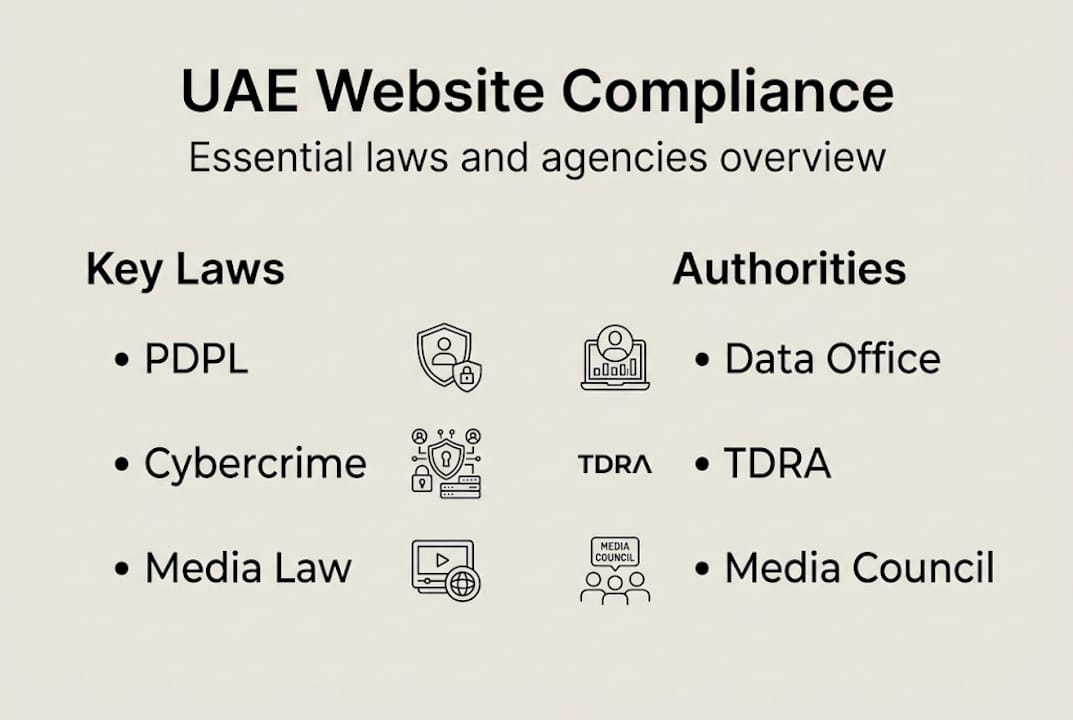
Here is a quick overview of the core laws and the authorities that enforce them:
| Law | What it covers | Enforcing authority |
|---|---|---|
| PDPL (No. 45/2021) | Personal data collection, storage, and processing | UAE Data Office |
| Cybercrime Law (No. 34/2021) | Online fraud, unauthorized access, harmful content | Cybercrime Prosecution |
| Media Law (No. 55/2023) | Online content standards, defamation, publishing rules | UAE Media Council |
For SMEs, the most immediately actionable obligations fall under the PDPL. PDPL compliance requires you to publish a privacy policy, obtain valid user consent, and have a process for reporting data breaches. These are not optional extras. They are legal minimums.
Core requirements every UAE SME website must meet include:
- A clear, accessible privacy policy explaining how you collect and use data
- A cookie consent mechanism (banner or similar) before tracking users
- Secure storage and transmission of any personal data collected
- A documented process for handling data subject access requests
- A breach notification procedure ready to activate within 72 hours
You can review the official UAE sources for the most current regulatory guidance, since enforcement priorities and technical requirements do evolve. Staying informed is part of compliance, not a one-time task.
Legal risk alert: Non-compliance with the PDPL can result in administrative fines, mandatory website suspension, and criminal liability for data misuse. Regulators are actively enforcing these rules, and SMEs are not exempt.
If you are building or upgrading your site, understanding website essentials for Dubai SMBs will help you see how compliance fits into the broader picture of a well-built business website. The compliance layer is not separate from good web design. It is part of it.
Preparing your website: Compliance prerequisites
Having clarified what the law demands, let’s prepare your website by building strong compliance foundations. Before you implement anything technical, you need to know what personal data your site actually collects. Many SME owners are surprised to discover how much data flows through a basic contact form, analytics tool, or e-commerce checkout.
Starting with a data audit and mapping out your data flows is the single most important first step. You cannot protect what you have not identified.

Compliance obligations also vary depending on where your business is registered. Here is a simplified comparison:
| Business type | Primary law | Additional requirements |
|---|---|---|
| UAE Mainland SME | PDPL (Federal) | UAE Data Office registration if processing sensitive data |
| DIFC Free Zone entity | DIFC Data Protection Law | GDPR-aligned rules, DIFC Commissioner oversight |
| ADGM Free Zone entity | ADGM Data Protection Regulations | Similar to GDPR, separate from federal PDPL |
Once you know where you stand, follow these initial steps in order:
- Map your data: List every point where your website collects personal information, including forms, analytics, chat tools, and payment processors.
- Draft and publish your privacy policy: This document must explain what data you collect, why, how long you keep it, and how users can request deletion or access.
- Set up a consent mechanism: Add a cookie consent banner that gives users a genuine choice before any non-essential tracking begins.
- Create a data register: Keep an internal record of all data processing activities. This is a formal requirement under the PDPL for many SMEs.
- Assess your Data Protection Officer (DPO) need: If your business processes sensitive data at scale, appointing a DPO is not optional.
Pro Tip: Your privacy policy costs almost nothing to create using reputable generators, but it must be customized to your actual data practices. A generic template that does not reflect your real operations can still expose you to liability.
When you are ready to move forward, reviewing website launch steps in Dubai will help you integrate compliance into your go-live checklist rather than treating it as an afterthought. Getting it right from the start saves significant time and cost later.
Executing compliance: Practical steps for your website
Once you have laid the groundwork, it is time to bring your website up to standard, step by practical step. Implementation is where most SMEs stall, usually because they do not know which tools to use or what “done” actually looks like.
Here is a clear action sequence:
- Deploy a consent management platform (CMP): Tools like Cookiebot or CookieYes let you display legally valid cookie banners and log user consent. Valid consent means users must actively agree before non-essential cookies fire, not just see a banner.
- Publish and link your privacy policy: Place the link in your site footer, on every form, and at checkout. It must be easy to find.
- Enable HTTPS across your entire site: Data in transit must be encrypted. An SSL certificate is the minimum standard and most hosting providers include it.
- Protect stored data: If your site stores customer records, ensure your database is access-controlled and regularly backed up to a secure location.
- Build a breach response workflow: Know who in your team is responsible for identifying, containing, and reporting a breach. Document the process before you need it.
Essential tools and features for UAE SME website compliance in 2026:
- Cookie consent manager (CookieYes, Cookiebot, or similar)
- SSL certificate (HTTPS enabled site-wide)
- Privacy policy generator with UAE-specific customization
- Data subject request form (for users to request data access or deletion)
- Security plugin or firewall (especially for WordPress-based sites)
- Regular automated backups to an off-site or cloud location
Pro Tip: Start with the free tiers of consent management tools. Most SME websites qualify, and you can upgrade only if your traffic volume or data complexity grows. Free does not mean non-compliant here.
A UX audit for compliance can reveal where your site’s user experience and legal requirements intersect. Poor UX around consent flows is one of the most common compliance gaps we see. If users cannot easily find or interact with your consent options, regulators may not consider that valid consent at all.
Verifying and maintaining compliance
Once compliance is implemented, regular verification keeps your site safe and ahead of changes. Compliance is not a project with an end date. It is an ongoing operational responsibility.
Here is what to check on a regular basis:
- Privacy policy currency: Review and update your policy whenever you add new tools, change data practices, or when the law is amended.
- Consent mechanism functionality: Test your cookie banner across browsers and devices to confirm it works correctly and logs consent accurately.
- Staff training records: Anyone who handles customer data needs to understand their obligations. Document your training sessions.
- Technical security audits: Run vulnerability scans at least quarterly. Look for outdated plugins, weak passwords, and unpatched software.
- Third-party vendor compliance: If you use marketing platforms, CRMs, or analytics tools, confirm they are also PDPL-compliant.
- Data subject request log: Track and respond to any requests from users to access, correct, or delete their data within the legally required timeframe.
Critical deadline: Data breaches must be reported to the UAE Data Office within 72 hours of discovery. Missing this window can significantly increase your legal exposure, even if the breach itself was minor.
Make it a habit to check UAE government data protection pages at least quarterly. Regulatory guidance updates regularly, and what was sufficient last year may not meet current standards. Set a calendar reminder so it does not slip.
Verified compliance also pays dividends beyond legal protection. Customers increasingly check for trust signals before sharing personal information online. A transparent, well-maintained privacy setup signals that your business is serious and trustworthy. This directly supports branding and trust for Dubai SMBs, turning a legal obligation into a genuine competitive advantage.
Why the conventional approach to website compliance in the UAE misses the mark
Most SME owners treat compliance as a one-time documentation exercise. They generate a privacy policy, add a cookie banner, and consider the job done. We have seen this pattern repeatedly across two decades of working with Dubai businesses, and it consistently creates risk rather than reducing it.
The uncomfortable truth is that static documents do not protect you. What actually protects your business is a living compliance culture: staff who know what to do when a data request arrives, a UX that makes consent genuinely easy for users, and a review cycle that catches gaps before regulators do.
Compliance done well is also a growth strategy. Customers who trust your site convert at higher rates. Partners and enterprise clients increasingly audit vendor compliance before signing contracts. Treating your launch steps for Dubai business websites as a compliance opportunity from day one positions your brand as credible and professional, not just legally covered.
Checkbox compliance gets you through an audit. Trust-centered compliance builds a business.
Need help building a compliant, trusted website?
If you want your website to stay compliant, trusted, and successful, expert help makes the difference. At DubaiWebCity, we have spent over 20 years helping UAE businesses build websites that are not only visually strong but legally sound from the ground up.

Whether you need creative web design solutions that incorporate compliance-ready UX, a robust CMS website development setup with built-in consent management, or a fully compliant e-commerce website development platform for your UAE store, our team handles the technical and legal layers together. Reach out to us today for a consultation and let’s make sure your website works for your business, not against it.
Frequently asked questions
What are the main website compliance laws in the UAE?
The main laws are the PDPL (No. 45/2021) for data protection, Decree-Law No. 34/2021 for cybercrimes, and Decree-Law No. 55/2023 for media standards. Your website content must also avoid defamation and meet national publishing rules.
Do I need a privacy policy on my UAE SME website?
Yes, every SME website collecting personal data must publish an up-to-date privacy policy. This is a direct PDPL requirement and non-compliance can result in fines or enforcement action.
How quickly must data breaches be reported in the UAE?
Data breaches must be reported to the UAE Data Office within 72 hours of discovery. Delays beyond this window increase your legal exposure significantly.
How do free zones like DIFC and ADGM affect website compliance?
DIFC and ADGM follow GDPR-style rules that are separate from the federal PDPL. If your business is registered in one of these zones, you must check both zone-level and federal requirements, especially if you serve UAE residents.