TL;DR:
- Continuous e-commerce optimization enhances site performance, customer experience, and sales in Dubai’s fast-growing market.
- Key pillars include technical speed, mobile UX, SEO, and marketing strategies to boost conversion rates.
- Ongoing testing and localized improvements are crucial for maintaining competitiveness and growth.
Getting your online store live feels like a major win. But in Dubai’s fast-moving e-commerce market, launching is just the starting line. The businesses pulling ahead are not the ones with the flashiest storefronts; they are the ones constantly refining how their site performs, converts, and retains customers. This guide breaks down what e-commerce optimization actually means, why it matters specifically in Dubai, and how you can apply its core pillars to grow sales, reduce cart abandonment, and build a shopping experience your customers keep coming back to.
Table of Contents
- What is e-commerce optimization?
- Key pillars of effective e-commerce optimization
- How e-commerce optimization benefits Dubai businesses
- Implementing e-commerce optimization: steps and common pitfalls
- Our take: Why continuous optimization is the Dubai secret weapon
- Ready to optimize your Dubai e-commerce site?
- Frequently asked questions
Key Takeaways
| Point | Details |
|---|---|
| Optimization is ongoing | E-commerce optimization means making regular, data-driven improvements for lasting success. |
| Dubai market is unique | Local shopper habits and fast-paced competition require tailored optimization strategies. |
| Big ROI from small changes | Simple steps like speeding up your site or streamlining checkout can drive major sales gains. |
| Measure and repeat | Track key metrics and refine your approach each quarter for maximum impact. |
What is e-commerce optimization?
There is a common misconception that once your store is live, the hard work is done. In reality, a live store that is not actively optimized is like a physical shop with poor lighting, confusing signage, and a broken cash register. Customers walk in, get frustrated, and leave.
E-commerce optimization is the ongoing process of improving sales, speed, and customer experience across every touchpoint of your online store. It is not a one-time project. It is a discipline.
In plain terms, optimization means asking: Why are visitors leaving without buying? Why does checkout take so long? Why is the mobile experience clunky? Then fixing those problems, measuring the results, and repeating the cycle.
“Optimization is not about perfection. It is about consistently making your store a little better for your customers every single week.”
For Dubai businesses specifically, the stakes are high. The UAE’s e-commerce sector is one of the fastest-growing in the Middle East, with shoppers who are digitally savvy, mobile-first, and quick to abandon sites that feel slow or untrustworthy. Your competitors are investing in optimization. If you are not, you are losing ground.
Here are the core areas that e-commerce optimization covers:
- Site speed: How fast your pages load on mobile and desktop
- User experience (UX): How easy it is for customers to find products and complete a purchase
- Conversion funnel: Every step from landing page to order confirmation
- Product discovery: Search filters, recommendations, and category navigation
- Mobile performance: Responsive design, tap-friendly buttons, fast mobile checkout
- Security and trust: SSL certificates, payment security badges, clear return policies
When you are building successful e-commerce sites in Dubai, these are not optional extras. They are the foundation of a store that actually sells.
Key pillars of effective e-commerce optimization
E-commerce optimization is not one single thing. It is a set of interconnected disciplines, each contributing to a different part of your store’s performance. Understanding these pillars helps you prioritize where to focus your energy and budget.
| Pillar | Focus area | Key success metric | Sample action |
|---|---|---|---|
| Technical | Speed, uptime, mobile | Page load time | Compress images, upgrade hosting |
| UX | Navigation, checkout flow | Conversion rate | Simplify checkout to 3 steps |
| SEO | Organic traffic, visibility | Organic sessions | Optimize product page titles |
| Marketing | Retention, re-engagement | Email open rate | Launch cart abandonment emails |
Technical optimization is the backbone. If your site loads slowly, nothing else matters. Dubai shoppers on mobile networks will not wait more than three seconds for a page to load. Fix your core web vitals, compress your images, and make sure your hosting can handle traffic spikes during peak shopping periods like Ramadan and White Friday.

User experience (UX) is where most Dubai stores leave money on the table. Mobile optimization can significantly increase conversion rates, yet many businesses still treat mobile as an afterthought. Think about UX for Dubai e-commerce as removing every possible reason a customer might hesitate or get confused.
SEO brings in the right visitors in the first place. There is no point optimizing a store that nobody finds. Targeting the right keywords, optimizing product descriptions, and building a clean site structure all contribute to sustainable organic traffic.
Marketing optimization keeps customers coming back. Retargeting ads, personalized email flows, and push notifications are powerful tools for re-engaging visitors who did not convert on their first visit. Review essential ecommerce features to ensure your platform supports these capabilities.
Here is how to prioritize which pillar to address first:
- Run a site speed audit and fix critical technical issues
- Analyze your checkout funnel for drop-off points
- Review your top product pages for UX and SEO gaps
- Set up basic marketing automation (cart abandonment emails)
- Measure results and repeat the cycle quarterly
Pro Tip: Start with site speed. It is the single change that delivers the fastest, most measurable impact in Dubai’s competitive mobile-first market. Even a one-second improvement can boost conversion with design tips and reduce bounce rates noticeably.
How e-commerce optimization benefits Dubai businesses
Optimization is not just a technical exercise. It produces real, measurable business outcomes that show up in your revenue, your customer satisfaction scores, and your search rankings.
The numbers are compelling. Sites that optimize see conversion lifts between 15 and 30 percent. For a Dubai store doing AED 100,000 a month in sales, that is an additional AED 15,000 to 30,000 without spending more on ads.
| Metric | Before optimization | After optimization |
|---|---|---|
| Conversion rate | 1.2% | 1.8% to 2.4% |
| Bounce rate | 65% | 42% |
| Page load time | 5.8 seconds | 2.1 seconds |
| Cart abandonment | 78% | 58% |
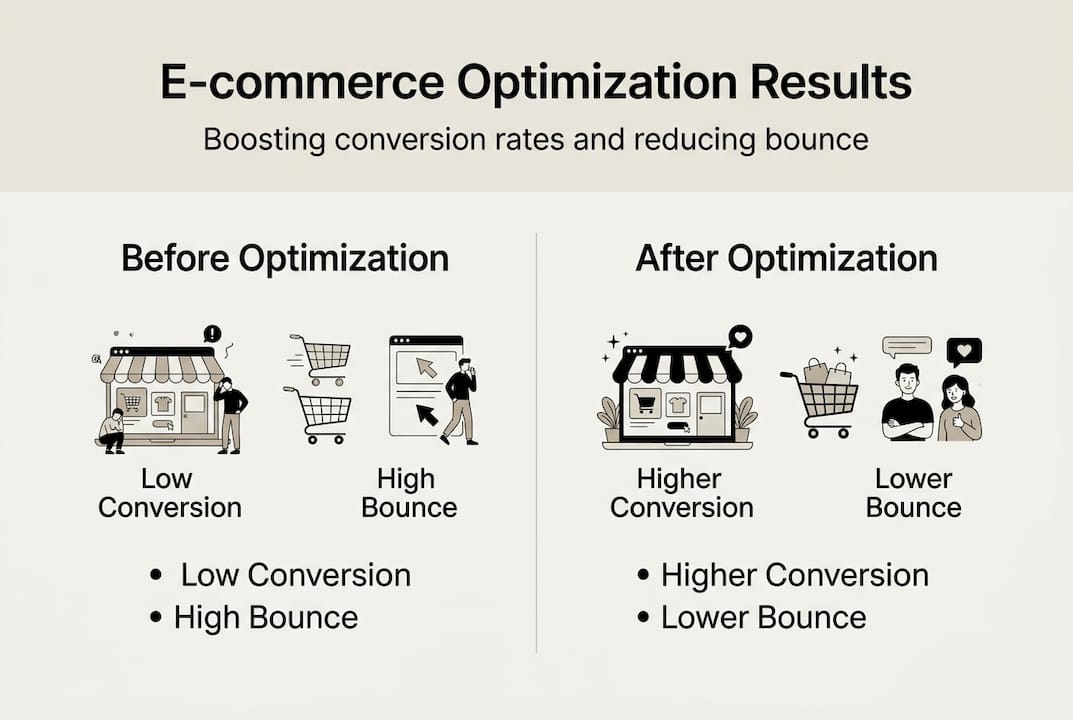
These are not theoretical numbers. They reflect what happens when Dubai businesses commit to improving user experience and technical performance in a structured, ongoing way.
Here is what you gain when you invest in proper optimization:
- Higher sales from the same traffic you are already paying for
- Happier customers who find what they need quickly and check out without friction
- Better search rankings from improved technical performance and on-page SEO
- Stronger mobile performance for Dubai’s predominantly mobile shopping audience
- Lower customer acquisition costs because your conversion rate improves
- Increased repeat purchases driven by a smoother, more trustworthy experience
Consider a Dubai fashion retailer that improved its mobile checkout flow and added local payment options like Apple Pay and cash-on-delivery. Within 90 days, cart abandonment dropped by 20 percentage points. That is the kind of result that ecommerce development for Dubai businesses can unlock when optimization is treated as a priority, not an afterthought. The custom website ROI from these changes compounds over time.
Implementing e-commerce optimization: steps and common pitfalls
Following an ordered, repeatable process is critical for sustainable optimization gains. Without structure, optimization becomes random and unmeasurable. Here is a practical framework you can start using today.
Step-by-step optimization process:
- Audit your current performance. Use tools like Google PageSpeed Insights, Hotjar, and Google Analytics to identify where users drop off and where your site is technically weak.
- Set clear KPIs. Define what success looks like before you make any changes. Conversion rate, bounce rate, average order value, and cart abandonment rate are your core metrics.
- Prioritize your changes. Focus on high-impact, low-effort fixes first. A faster homepage or a simplified checkout often delivers more value than a full redesign. Your website redesign strategy should be data-driven, not opinion-driven.
- Test and measure. Run A/B tests where possible. Change one variable at a time so you know what is actually driving results.
- Repeat the cycle. Optimization is never finished. Set a quarterly review schedule and treat it like a standard business operation.
Now, the pitfalls. These are the mistakes we see Dubai e-commerce managers make most often:
- Ignoring mobile users. Over 70% of UAE online shoppers browse and buy on mobile. A desktop-first mindset costs sales.
- Slow or complicated checkout. Every extra step in your checkout process increases abandonment. Review your ecommerce features checklist to ensure your platform is built for speed.
- Not measuring before and after. Making changes without baseline data means you cannot prove what worked.
- Treating optimization as a one-time project. Markets shift, algorithms update, and customer expectations evolve. What worked in 2024 may not work in 2026.
- Skipping localization. Dubai shoppers expect Arabic language options, local currency, and familiar payment methods. Missing these is a conversion killer.
Pro Tip: Schedule a quarterly optimization review in your business calendar the same way you would schedule a financial review. Assign an owner, set agenda items, and track progress against your KPIs. Consistency beats intensity every time.
Our take: Why continuous optimization is the Dubai secret weapon
Here is something most agencies will not tell you: the flashy website launch is not your competitive advantage. Your advantage is what you do in the 12 months after launch.
We have worked with Dubai businesses across retail, hospitality, and services since 2004. The ones that grow consistently are not the ones with the biggest launch budgets. They are the ones that treat their website as a living product, not a finished deliverable. They test a new checkout layout. They adjust their mobile navigation based on heatmap data. They add a local payment option because their customers asked for it.
Dubai’s digital culture moves fast. Consumer expectations in this market shift faster than almost anywhere else in the region. A site that felt modern in early 2025 can feel dated by mid-2026. Continuous optimization is how you stay relevant without rebuilding from scratch every two years.
The businesses winning in Dubai’s e-commerce space are not chasing perfection. They are stacking small wins. That mindset, applied consistently, is the real digital success strategy that separates growing stores from stagnant ones.
Ready to optimize your Dubai e-commerce site?
If this guide has shown you one thing, it is that optimization is not a luxury reserved for enterprise brands. It is the practical, ongoing work that turns a good store into a great one.

At DubaiWebCity, we offer full-service e-commerce development built around performance, UX, and measurable growth. From site speed audits and mobile commerce upgrades to SEO optimization for Dubai e-commerce and creative web design that converts, our team has the local expertise to help you compete and win. Whether you need a full platform overhaul or targeted improvements to your existing store, we are ready to help you take the next step.
Frequently asked questions
Which parts of my e-commerce site should I optimize first?
Start with page speed and mobile usability. Technical performance and mobile UX have the greatest initial impact on conversions, making them the highest-priority fixes for any Dubai store.
How do I measure the results of e-commerce optimization?
Track KPIs like conversion rate, bounce rate, and average order value before and after every change. Conversion, bounce rate, and order value together give you a clear picture of whether your optimization efforts are working.
Is e-commerce optimization a one-time project?
No. Sustainable gains require repeatable and ongoing optimization cycles. Customer expectations, algorithms, and market conditions all change, so your store needs to keep pace.
What optimization strategies help reduce cart abandonment in Dubai?
Faster checkouts, local payment options like Apple Pay and cash-on-delivery, and clear shipping information are the most effective levers. Usability and process clarity directly decrease the rate at which shoppers abandon their carts.
Do Dubai e-commerce sites need different optimization compared to other regions?
Yes. Dubai’s digital culture shapes optimization strategies in unique ways, including the need for Arabic language support, local payment methods, and a mobile-first design approach that matches how UAE shoppers actually browse and buy.
Recommended
- Building E-Commerce Sites in Dubai for Business Success
- App Store Optimization Dubai – Web Design Dubai – Website Design Company Dubai | NetSoft
- Shopify Ecommerce Development – Web Design Dubai – Website Design Company Dubai | NetSoft
- Big Commerce Development – Web Design Dubai – Website Design Company Dubai | NetSoft